
AAMA 2603 is the entry-level standard. One year of Florida exposure testing. Acceptable for interior applications and light-duty exterior use. Not appropriate for a structure that sits in San Diego sun 260 days a year.
Galvanized steel patio covers fabricated and powder coated in-house — your choice of over 150 colors, built to fit your property exactly.
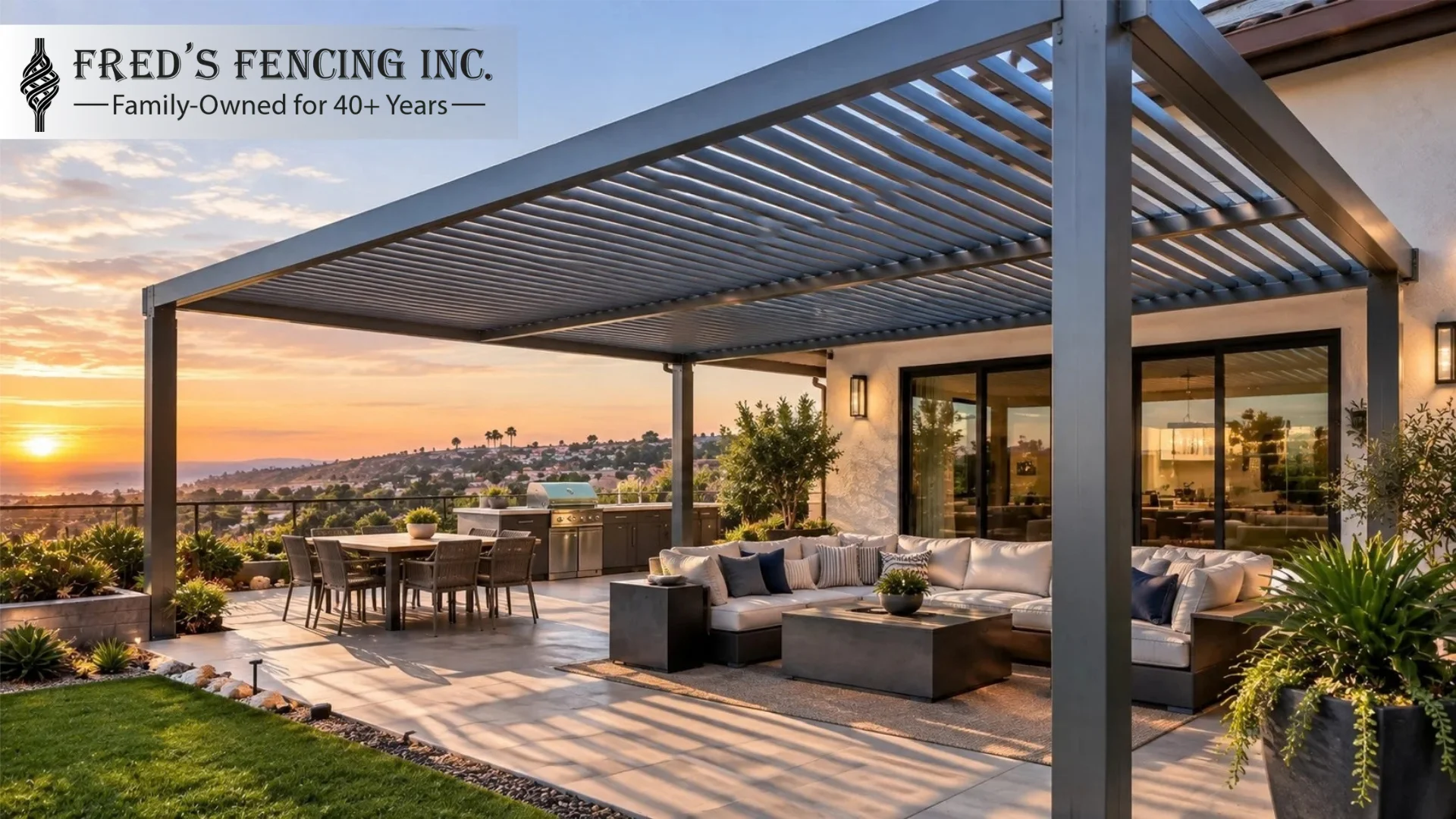
Every patio cover we build starts as raw galvanized steel tubing in our 12,000 square foot fabrication facility in Santee. We cut, weld, and assemble the frame to the exact dimensions of your patio — not the nearest standard size from a manufacturer's catalog. We powder coat it in-house in the color you choose from our library of over 150 options. And we install it on your property with the same crew that built it.
This is not a prefab kit. Prefab aluminum covers come in fixed sizes — 10x12, 12x16, 12x20 — and if your patio is 11x18, you either settle for a size that does not fit or pay for custom modifications after the fact. Our covers are fabricated to your measurements from the start. Odd angles, irregular rooflines, step-downs, and non-standard post locations are all accounted for before a single weld is made.
Fred's Fencing Inc. has operated this fabrication facility since 1984. The same shop that produces our iron fencing, custom gates, and railings now builds custom patio covers using the same pre-galvanized steel tubing, the same welding standards, and the same in-house powder coating process we have refined over four decades.
Prefab patio cover kits ship in fixed dimensions — 10x12, 12x16, 12x20 — with fixed post heights of 8, 9, or 10 feet and maximum projection depths of 12 to 14 feet. If your patio does not fit those numbers, the kit does not fit your patio.
We have no catalog sizes. We fabricate to whatever footprint your property requires — 9x22, 14x31, an L-shaped wrap around two sides of the house, a trapezoid that follows an angled property line. Projection depth is engineered per project, not limited by a manufacturer's standard panel length. Post height is set to whatever your design calls for within the 12-foot maximum allowed under California Residential Code Appendix AH. A 7-foot clearance for a low-profile modern look or an 11-foot ceiling over an outdoor kitchen — we build to the height, not to a kit.
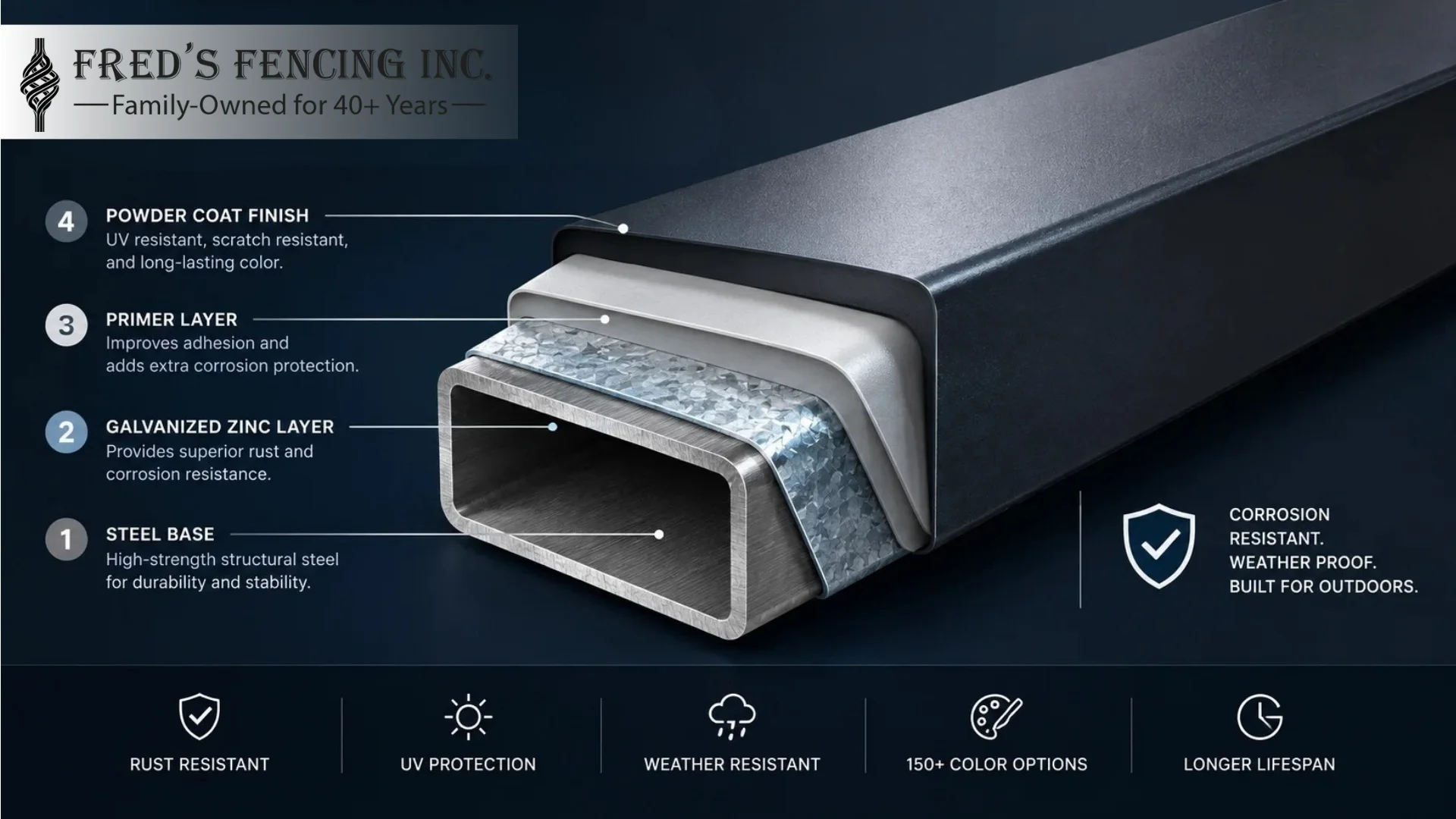
Galvanized steel is steel coated in a protective layer of zinc through a hot-dip process. The zinc acts as a sacrificial barrier — it corrodes first, before the underlying steel is ever exposed. This gives galvanized steel a base lifespan of 50 or more years against environmental corrosion, even before any additional finish is applied.
When we add a powder coat finish on top of the galvanization, the structure gets dual protection: the zinc layer handles corrosion from underneath, and the powder coat handles UV, color retention, and surface wear from the outside. Two independent barriers, each protecting against different threats.

Most patio cover contractors in San Diego work exclusively with aluminum. It is lighter, naturally rust-proof, and comes in prefab kits that install quickly. For standard rectangular covers with no structural demands, aluminum works fine. Galvanized steel earns its place when the project needs something aluminum cannot deliver.
Steel is approximately 200% stronger than aluminum at equivalent thickness. That means thinner, more elegant beam profiles can span wider distances without sagging or deflection. A 16-foot unsupported span that would require a bulky 4x8-inch aluminum beam can be achieved with a slimmer steel section — cleaner lines, less visual weight.
Steel is also fully weldable. Our fabricators can shape steel into curves, tapers, arched headers, and custom bracket configurations that bolted aluminum extrusion systems simply cannot replicate. If your design calls for anything beyond a straight rectangular frame, steel is the material that makes it possible.
Where aluminum wins: within one mile of the coast, where salt-air corrosion is most aggressive, aluminum's natural oxide layer provides maintenance-free protection that galvanized coatings must work harder to match. For coastal properties in La Jolla, Del Mar, Encinitas, and Pacific Beach, we discuss both options and recommend based on proximity and exposure.
The standard patio cover comes in white. Maybe gray. Sometimes brown. That is the reality with prefab kits — 2 to 8 color options chosen by the manufacturer, not by you.
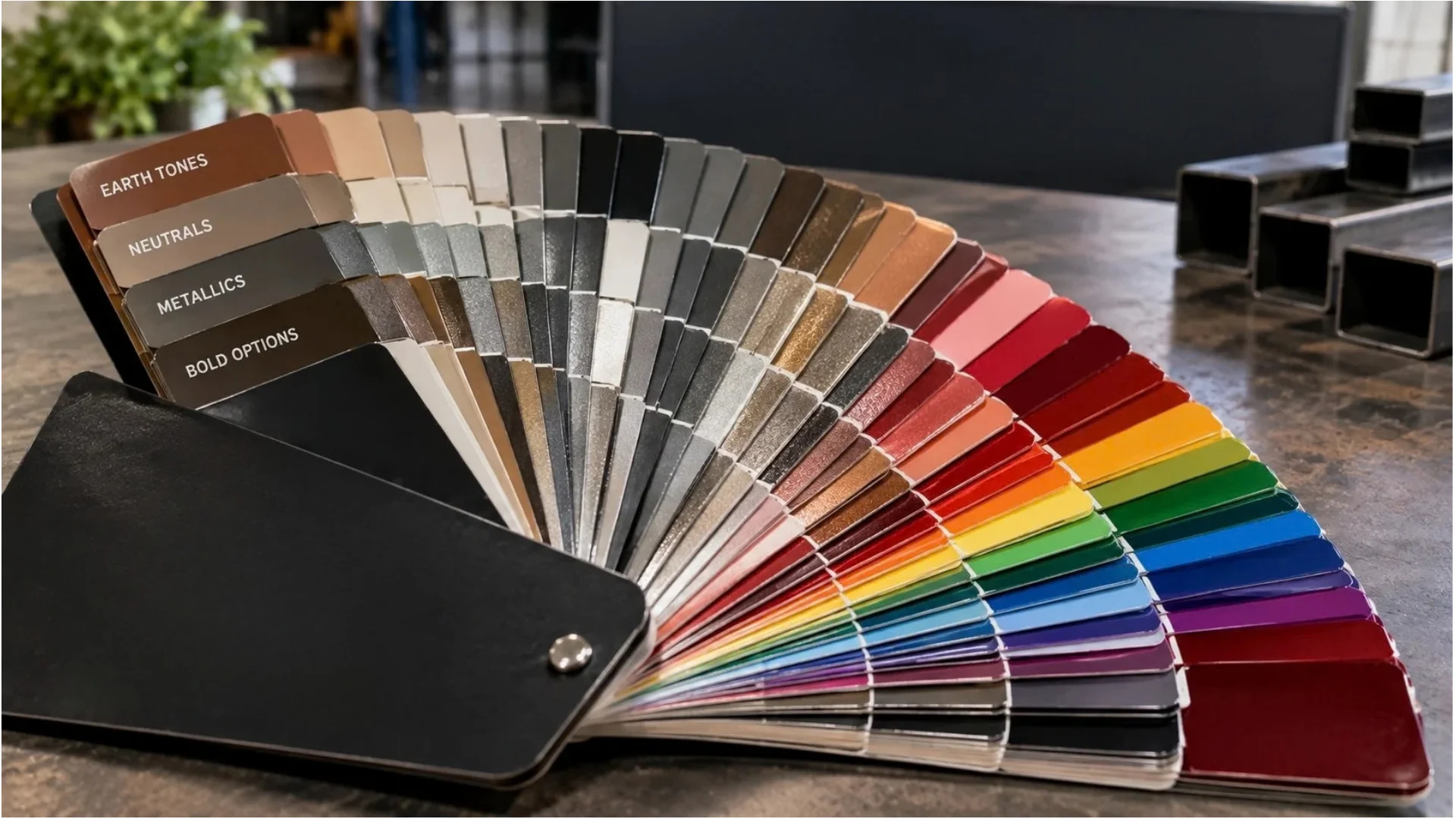
Our in-house powder coating line applies color electrostatically and cures it at 400°F, bonding the finish permanently to the metal surface. We stock over 150 RAL and custom colors across the full spectrum — earth tones, neutrals, metallics, bold accents, and everything between. Gloss, satin, matte, and textured finishes are all available.

The goal is integration, not decoration.
A patio cover should look like it was always part of the house.
Match warm stucco (beige, terracotta, sand) with bronze, dark brown, or sandstone finishes. Match cool exteriors (gray stucco, blue-gray trim) with charcoal, slate, or graphite. If your roof tile is visible from underneath the cover, match or complement its tone so the transition reads naturally. For a contemporary architectural statement, a contrasting dark frame against light stucco creates intentional visual contrast — black steel on white stucco is a look that has become increasingly popular in San Diego's newer construction.
Match warm stucco with bronze, dark brown, or sandstone finishes.
Match cool exteriors with charcoal, slate, or graphite.
For a contemporary architectural statement, a contrasting dark frame against light stucco creates intentional visual contrast — black steel on white stucco is a look that has become increasingly popular in San Diego's newer construction.
If your roof tile is visible from underneath the cover, match or complement its tone so the transition reads naturally.
HOA-restricted properties are common in communities across Rancho Bernardo, Scripps Ranch, 4S Ranch, Carmel Valley, and Eastlake. Many HOAs limit patio cover colors to specific earth tones or RAL numbers. We match any specification your HOA requires.
Not all powder coatings perform the same. The American Architectural Manufacturers Association (AAMA) rates powder coatings in three tiers based on how they hold up to real-world UV exposure, measured through accelerated weathering tests in South Florida:
AAMA 2603 is the entry-level standard. One year of Florida exposure testing. Acceptable for interior applications and light-duty exterior use. Not appropriate for a structure that sits in San Diego sun 260 days a year.
AAMA 2604 is the high-performance tier, commonly called “Super Durable.” Five years of Florida exposure testing. Color shift must stay within 5 Hunter units, and gloss retention must hold above 30%. This is the standard we apply on every exterior patio cover we build. It means the color you see on installation day is the color you will see five years later.
AAMA 2605 is the architectural-grade tier — “Hyper Durable.” Ten years of Florida exposure testing with 50% or more gloss retention. This is specified for high-rise curtain walls and coastal commercial buildings. We offer 2605-rated coatings for San Diego coastal properties where maximum UV and salt resistance is justified.
No other patio cover contractor in San Diego publishes which AAMA tier they use. We do, because the rating is the only objective measure of how long your finish will actually last.
Ask for your finish specFull shade or filtered light, tied into the house or standing on its own — every configuration is fabricated from the same galvanized steel.
A solid roof provides full shade and complete rain protection. Galvanized steel frame with metal panel roofing, integrated gutters, and optional downspout routing. This is the standard for outdoor kitchens, dining areas, and any space where you need dry, shaded coverage year-round.
Open steel rafters with controlled spacing allow filtered sunlight through while providing partial shade. The rafter width, depth, and spacing determine how much light passes and at what angle. This configuration suits poolside areas, garden patios, and properties where full shade is not the goal.
Both are built from the same galvanized steel and both are engineered to the same code. The difference is where the load goes.
An attached cover ties into your house with a ledger board fastened to the existing structure. One end of the cover is supported by the house; the other rests on posts. This is the most common configuration for extending living space directly off a back door or sliding glass entry.
A freestanding cover stands on its own posts with no connection to the house. This suits poolside shade structures, detached outdoor kitchens, and properties where the house wall cannot support a ledger (stucco over foam sheathing, for example, requires additional structural blocking).
The City of San Diego may exempt patio covers from a building permit if the projected roof area is 300 square feet or less, the structure is single-story, does not exceed 12 feet in height, and does not encroach into required setbacks. This exemption applies to single-family and duplex residential properties per Information Bulletin 206.
The exemption does not apply if the property is in the Coastal Zone, within a historic district, on environmentally sensitive lands, or regulated by a Planned Residential Development permit.
Any electrical work — lights, ceiling fans, outlets — requires a separate electrical permit regardless of the cover's size.
At 300 sq ft or less, single-story, 12 ft or under and outside setbacks, a City of San Diego cover may be exempt — unless the property is in the Coastal Zone, a historic district, sensitive lands or a PRD.
Electrical work always needs a separate electrical permit.
A guide only, based on current published thresholds. We confirm the requirement for your address during the site visit — and handle the permit either way.
In Santee, where our shop is located, the threshold is stricter: permits are required for patio covers 120 square feet and larger. Other San Diego County cities vary — Carlsbad and Solana Beach follow the 300 square foot threshold, while Vista does not require permits at any size.
Governs all patio covers statewide.
California Residential Code Appendix AH governs all patio covers statewide: maximum 12 feet height, at least 65% of the longer wall and one additional wall must remain open or glazed, used only for outdoor recreational living, and minimum 5-foot setback from property lines.
Maximum height
Of the longer wall and one additional wall must remain open or glazed
Minimum setback from property lines
Used only for outdoor recreational living
We handle the full permit process — plan preparation, structural engineering calculations, submittal, and inspection coordination. If your property has an HOA, we prepare and submit architectural review documents as well.
Installed prices per square foot, by cover type — with aluminum prefab and wood for comparison. Exact pricing follows an on-site measurement.
Galvanized steel solid roof covers (custom fabricated and powder coated): $25 to $55 per square foot installed. Galvanized steel lattice or pergola-style covers: $20 to $40 per square foot installed. Insulated panel covers: $30 to $60 per square foot installed.
For comparison, standard aluminum prefab covers run $20 to $50 per square foot installed, and wood covers range from $60 to $120 per square foot.
A 10x12 cover (120 sq ft) typically runs $3,000 to $6,600 installed. A 12x20 cover (240 sq ft) falls between $6,000 and $13,200. A 16x20 cover (320 sq ft) ranges from $8,000 to $17,600.
Uses the per-square-foot ranges above. Excludes electrical and site-specific work; your exact price comes after an on-site measurement.
Size and span length — wider unsupported spans require heavier beam sections.
Solid roof vs. open lattice — solid roofing adds panel material, gutters, and more labor.
Insulated vs. non-insulated panels — insulated cores add $10 to $15 per square foot.
Powder coating tier — AAMA 2605 coatings cost more than standard 2604.
Electrical integration — running wiring for lights, fans, or outlets adds material and a licensed electrician.
Site conditions — slope, soil type, existing structure attachment, and access all affect labor.
Permit and engineering fees — required for covers over 300 square feet in the City of San Diego.
We price after measuring on-site — free estimate.
We measure your patio on-site — roof attachment points, post locations, grade, drainage direction, and any obstructions.
We prepare a design with structural engineering calculations that satisfy permit requirements and your aesthetic goals.
We submit for permits and HOA approval where applicable.
We fabricate the entire structure in our Santee shop — cutting, welding, sandblasting, and powder coating — so the finished product arrives at your property ready to install.
We set footings, anchor posts, assemble the frame, attach panels, and integrate any electrical.
We coordinate the final city inspection and walk you through the completed installation.
Galvanized steel, fabricated and powder coated in our Santee shop since 1984, in any of over 150 colors. Permits handled.
No. We fabricate every cover to order — there is no maximum or minimum footprint. Any size, any projection depth, and any post height within the 12-foot code maximum.
Larger spans may require intermediate support posts depending on the engineering, but the cover itself can be built to any dimension your property needs.
Galvanized steel covers run $20 to $55 per square foot installed depending on type (solid, lattice, insulated), size, and finish tier. A standard 12x20 cover typically falls between $6,000 and $13,200.
We provide exact pricing after an on-site measurement.
In the City of San Diego, covers 300 square feet or smaller on single-family properties may be exempt. Covers over 300 square feet require a building permit. Electrical work always requires a separate permit.
Santee requires permits for covers 120 square feet and larger. We handle all permitting.
Galvanized steel is approximately 200% stronger than aluminum, allowing thinner profiles and wider spans. It is fully weldable into custom shapes. Aluminum is lighter, naturally rust-proof, and lower maintenance in extreme coastal exposure.
We offer both and recommend based on your property, span requirements, and proximity to the coast.
The galvanized zinc coating provides 50+ years of base corrosion protection. An AAMA 2604-rated powder coat adds 5 or more years of color and gloss retention on top of that.
With periodic cleaning and inspection, a galvanized steel patio cover is a multi-decade structure.
Yes. We stock over 150 powder coating colors and can custom-match any RAL number, Pantone reference, or physical sample. Gloss, satin, matte, and textured finishes are available.
Fabrication takes 1 to 2 weeks after final measurements. On-site installation typically completes in 1 to 3 days depending on size, foundation requirements, and electrical scope.
Yes. Attached covers are our most common configuration. We fasten a ledger board to the house structure and verify the attachment meets structural load requirements.
If the existing wall framing needs reinforcement, we handle that as part of the project.
Yes. We prepare plans, submit for permits, coordinate inspections, and handle HOA architectural review submittals. The permit process is included in our project scope.