Security
A locked gate forces uninvited visitors to reconsider. It won't stop a determined burglar, but it raises the difficulty enough to send many looking elsewhere.

In San Diego, a driveway gate is more than just an entrance. It shapes how your home looks from the street, adds security, and tells visitors something about what matters to you.
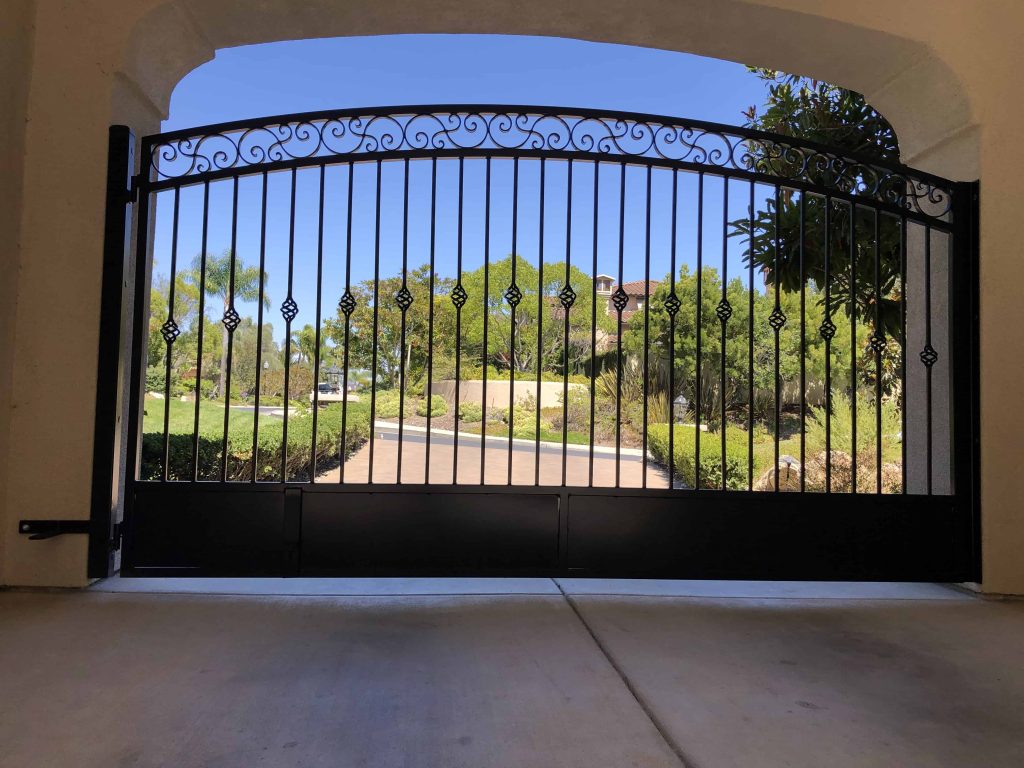
According to the National Association of Home Builders, 78% of home buyers say they view automated entry systems as a desirable feature when shopping for property. That figure climbs even higher in neighbourhoods with larger lots or privacy concerns. Whether you're blocking off a hillside estate in La Jolla or keeping your kids safe in a suburban cul-de-sac, a well-installed driveway gate does real work every day.
Driveway gates are barrier systems installed at property entrances that operate manually or automatically to control vehicle access, improve curb appeal, and enhance security through swing or slide mechanisms.
A driveway gate is a movable barrier placed at your property's entrance. Most residential setups use either swing gates or sliding gates. Swing gates open inward or outward on hinges, much like oversized doors. Sliding gates roll horizontally on a track. Both styles can be automated with motors and access controls, or left manual for occasional use.
Materials range from wrought iron and steel to wood and vinyl composites. The choice depends on your aesthetic, maintenance tolerance, and how much wind or salt exposure your location gets. Coastal homes near Point Loma or Ocean Beach need corrosion-resistant finishes. Inland areas like Poway or Santee can afford heavier wood panels.
Operation typically involves a motor, a control board, and some kind of opener. Trigger the system and the loop runs in the same order every time.
That is the basic loop. Everything beyond it is a choice, not a requirement — and we'll tell you which choices actually earn their cost on your driveway.
Six reasons customers give us on the driveway, in roughly the order we hear them.
San Diego homeowners install driveway gates to deter trespassers, increase property value, add architectural interest, control pet and child access, and reduce street noise in busy neighbourhoods.
A locked gate forces uninvited visitors to reconsider. It won't stop a determined burglar, but it raises the difficulty enough to send many looking elsewhere.
A solid gate closes the sightline from the street into your yard, so what happens on your property stays on your property.
An iron gate with decorative scrollwork or a timber entry framed by stone pillars changes how your property photographs and how guests perceive your home.
Automated gates keep toddlers from wandering toward the street and stop dogs from bolting after delivery trucks.
Appraisers and buyers view quality gates as an amenity. Homes with gated entries often sell faster and command higher offers in competitive markets.
Solid wood or composite gates dampen road noise from busy corridors like Mira Mesa Boulevard or El Cajon Boulevard.
The crew measures the opening, notes any slope, and confirms power access if you want automation.
Most cities in San Diego County require a building permit for automatic gate installations. Your fence company San Diego should handle the paperwork and inspections.
Workers dig holes for hinge posts or track footings, pour concrete, and let it cure for at least 24 hours.
The gate panels arrive pre-welded or are assembled on site. Hinges or rollers are attached, and the gate is hung or set onto the track.
The installer mounts the motor, runs conduit for power and sensor wires, and programs the control board.
The crew cycles the gate multiple times, checks sensor alignment, and adjusts tension or limit switches to prevent binding or overrun.
Most residential installations take one to three days depending on gate size, automation complexity, and any custom metalwork. Larger commercial gates with intercoms and card readers take longer.
Each style suits a different driveway, slope and budget. Hover a card for its typical cost range.
San Diego homeowners choose from swing gates, sliding gates, cantilever gates, bi-fold gates and barrier arm gates — each suited to different driveways, slopes, space constraints and aesthetic preferences.
 $2,500–$5,000
One leaf on hinges. Classic, simple, and the cheapest way to close a narrow opening — as long as there's room for the arc.
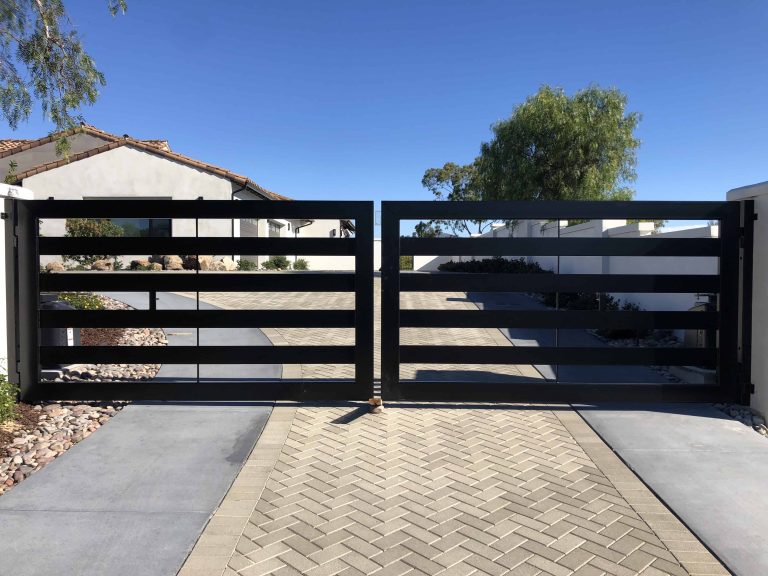 $4,000–$8,000
Two leaves that meet in the middle. Halves the swing depth of a single gate and gives the entrance a balanced, symmetrical look.
 $3,500–$7,500
Rolls sideways on a ground track instead of swinging out. The standard answer for a sloped driveway or an opening with nothing behind it.
 $5,000–$10,000
Floats above the ground on a cantilevered track, so debris can never jam the mechanism. No ground track to sweep or repair.
 $6,000–$12,000
Folds in the middle as it opens, cutting the required clearance in half. The fastest-opening option, and the most modern-looking.
 $3,000–$6,000
A single arm that lifts and drops in seconds. Fast and simple for high-volume access — but it offers no privacy at all.
Swing gates are classic and work well if you have room for the arc. Sliding gates suit driveways that slope or lack clearance on one side. Cantilever gates float above the ground on a cantilevered track, so ice or debris won't jam the mechanism. Bi-fold gates fold in the middle, cutting the required clearance in half. Barrier arms are fast and simple but offer no privacy.
Choose driveway gate contractors who hold valid California contractor licences, carry liability and workers' compensation insurance, provide written warranties, offer detailed estimates, and show recent local project photos.
Confirm the contractor holds a California C-13 fencing licence and carries both general liability and workers' compensation insurance. Ask for the policy numbers and verify them with the carrier. A licensed contractor knows local codes and won't disappear if something goes wrong.
Request references from jobs completed in the past year and go look at them. Check weld quality, paint finish, and how the gate sits in the opening. Ask past clients about communication, cleanup, and whether the crew showed up on schedule.
Get a written estimate that breaks down materials, labour, permits, and any extras like keypads or intercoms. Vague quotes often hide surprise charges. A good installer will visit your property, measure in person, and discuss options before quoting a final number.
Check that the company warranties both parts and labour. Most reputable outfits cover workmanship for at least one year and pass along manufacturer warranties on motors and control boards. If they won't put the warranty in writing, keep looking.
Run any bidder — us included — past this list. If a box can't be ticked, that is the conversation to have before money changes hands.
Fred's Fencing has been family-run since 1984, fabricates in our own Santee shop, and is licensed, bonded and insured. Ask us for any of the six — we'll hand them over.
Smart gate controllers replace traditional keypads and remotes with app-based access — open or close from your phone, grant temporary codes to guests or delivery drivers, and get an alert every time the gate moves.
Modern driveway gates integrate with smart home systems through Wi-Fi controllers, smartphone apps, voice assistants, video intercoms and automated scheduling, allowing remote access and activity monitoring from anywhere.
Open or close the gate from your phone, anywhere, and hand out temporary codes instead of spare remotes.
Say "open the driveway gate" to Amazon Alexa or Google Assistant once the system is linked through a compatible hub.
See and speak with visitors before granting access — useful when you're not home or don't recognise the vehicle.
Hold the gate open for the morning rush and closed the rest of the day, with no manual input at all.
Every event stamped with a time, plus alerts on open and close — so you know exactly when your teenager came home.
Automated scheduling opens and closes the gate at set times. If you want the gate open from 7 to 9 a.m. for morning traffic and closed the rest of the day, the system handles it without manual input.
Integration with other smart devices — porch lights, security cameras — creates layered automation that responds to gate activity, rather than five apps that each do one thing.
Maintenance isn't complicated, but skipping it leads to expensive repairs. Four jobs, on four different clocks — three you can do yourself.
Maintain driveway gates by lubricating hinges and rollers quarterly, cleaning sensors monthly, inspecting weld points for rust, testing safety reversals, and scheduling annual motor tune-ups with a technician.
Spray white lithium grease on hinges, rollers and chain drives. Wipe away old grease and debris first so you're not trapping grit.
Wipe the lenses with a microfiber cloth, then place a box in the gate's path and trigger closing. It should stop and reverse immediately.
Sand bubbling paint and apply rust-inhibiting primer before repainting — especially near the coast. Wood gates need annual sealing or staining, or panels crack and hinges sag.
The tech checks motor mounts, adjusts limit switches, inspects electrical connections and tests the backup battery. It prevents bigger problems down the road.
Keep a manual release key accessible inside your garage or home. If the power goes out or the motor fails, you can unlock the mechanism and swing or slide the gate by hand.
Someone bumps a post or the ground settles, and the gate stops mid-cycle or refuses to close at all.
After several years of daily use you'll hear grinding, or notice the gate moving slower than usual.
Skip the grease and rust builds up, binding the movement and putting the whole load back onto the motor.
Slack shows up as jerky starts and stops — the gate lurches rather than gliding.
The simplest issue on the list, and the one most often overlooked when a gate stops responding.
A gate can cut your premium and raise what you need to insure at the same time. Both are worth a phone call to your agent once the install is finished.
Installing a driveway gate may lower home insurance premiums by 2% to 5% because insurers view automated gates as theft deterrents, though you should notify your carrier to update coverage limits.
Some insurers offer discounts for security features that reduce break-in risk, and a gated driveway falls into that category. The discount isn't automatic — contact your agent and ask whether your policy includes security upgrade incentives. You may need photos or an invoice proving the installation.
The gate adds value to your property. If your coverage limits are based on your home's rebuild cost, increase those limits slightly to account for the gate. Otherwise you're underinsured if a fire or storm destroys the gate along with your home.
If your gate malfunctions and injures someone, your homeowner's liability coverage should respond. Make sure your policy includes at least $300,000 in liability protection. Higher limits cost more but protect you if a lawsuit exceeds the base amount.
General guidance only, based on how carriers commonly treat security upgrades. We build gates — we don't sell insurance, so confirm any figure with your own carrier before you count on it.
San Diego's population grew by 7% between 2010 and 2020, according to the U.S. Census Bureau, and much of that growth spread into suburban neighbourhoods with larger lots and longer driveways. As more families settle in areas like Scripps Ranch, Carmel Valley and Rancho Peñasquitos, demand for privacy and security features climbs. An automatic gate installation that once seemed like a luxury now feels practical when your street sees more traffic and your neighbours are farther apart.
Fred's Fencing serves homeowners across San Diego County, from coastal communities to inland suburbs. Whether you need a sliding gate to handle a sloped driveway or a decorative iron swing gate to match your chain link fence, local contractors understand the permitting quirks and soil conditions that affect installation. Working with experienced wood fence installers who also handle gate projects ensures your entire perimeter looks cohesive and functions reliably.
| Suburb | Approx. distance | Approx. drive time |
|---|---|---|
| La Jolla | 12 miles | 20 minutes |
| Poway | 18 miles | 25 minutes |
| Chula Vista | 10 miles | 18 minutes |
| Escondido | 25 miles | 35 minutes |
| Carlsbad | 30 miles | 40 minutes |
Our shop is at 10560 Kenney St, Santee, CA 92071, open Mon–Fri, 9:00 AM–5:00 PM. Come pick your material in person — the gate is fabricated on site.
Driveway entries built and installed across San Diego County. Tap any photo to enlarge it.
A driveway gate changes how your home functions and how it looks from the street. It keeps your family safer, your yard more private, and your property value higher. If you've been putting off the project because it seemed complicated or expensive, now is the time to get an estimate and see what's possible.
Contact Fred's Fencing today to schedule a site visit and discuss your options. Whether you want a simple manual swing gate or a fully automated system with smartphone control, we design, fabricate and install the right solution for your San Diego home — and handle the permits that come with it.
No pressure, no surprise line items — just a clear path from first call to a gate that opens on command.
Yes — most cities in San Diego County require a building permit for automated driveway gates. Your contractor should handle the permit application and schedule required inspections. Manual gates may not require a permit, but check with your local building department.
A well-maintained driveway gate lasts 15 to 25 years. Metal gates with quality finishes endure longer than wood or vinyl. Motors and control boards typically need replacement every 10 to 15 years depending on usage frequency.
You can install a manual gate if you have welding and concrete skills, but automated systems require electrical knowledge and permit compliance. Hiring a licensed contractor ensures the installation meets code and operates safely.
Swing gates open like doors on hinges and require clearance for the arc. Sliding gates roll horizontally on a track and work better for sloped driveways or tight spaces. Sliding gates also handle wind better in exposed locations.
Automating a manual gate costs $1,500 to $3,500 depending on gate size, weight and control features. The work includes mounting a motor, running power, installing sensors, and programming remotes or keypads.
Most automated gates include a backup battery that provides 10 to 20 cycles during an outage. You can also manually release the motor and operate the gate by hand if the battery dies.
Choose marine-grade steel with hot-dip galvanizing and powder-coat finishes. Inspect the gate quarterly for paint chips and rust spots, then sand and repaint immediately. Regular washing removes salt buildup that accelerates corrosion.