How to Protect Outdoor Metal Gates From Coastal Corrosion
By the Fred’s Fencing Inc. team, San Diego County gate fabricators since 1984
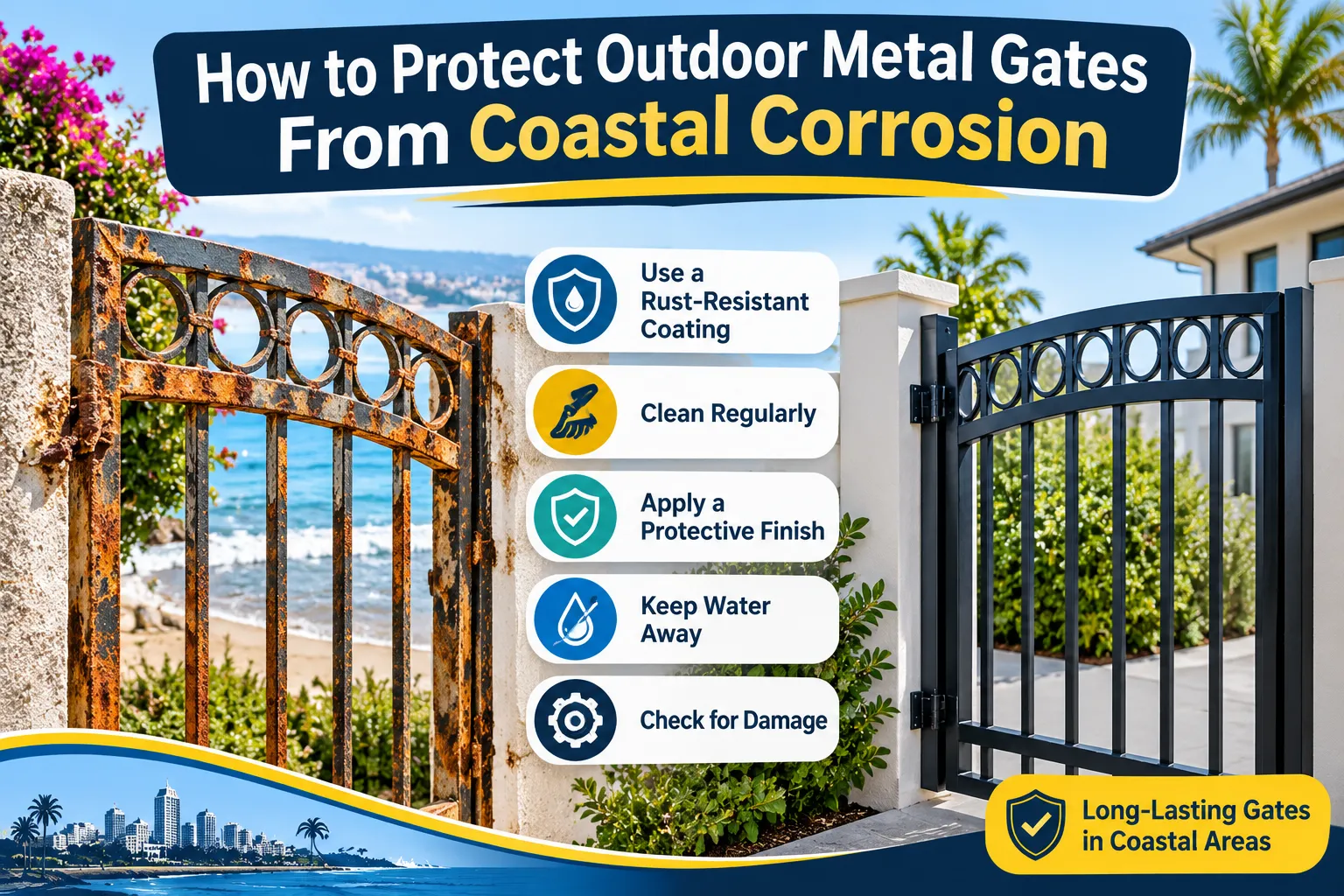
Salt air does not care how much a gate cost. Within a few seasons, a poorly protected steel gate near the beach can show orange streaks at every weld and hinge. The good news is that coastal rust follows predictable rules, and it can be stopped.
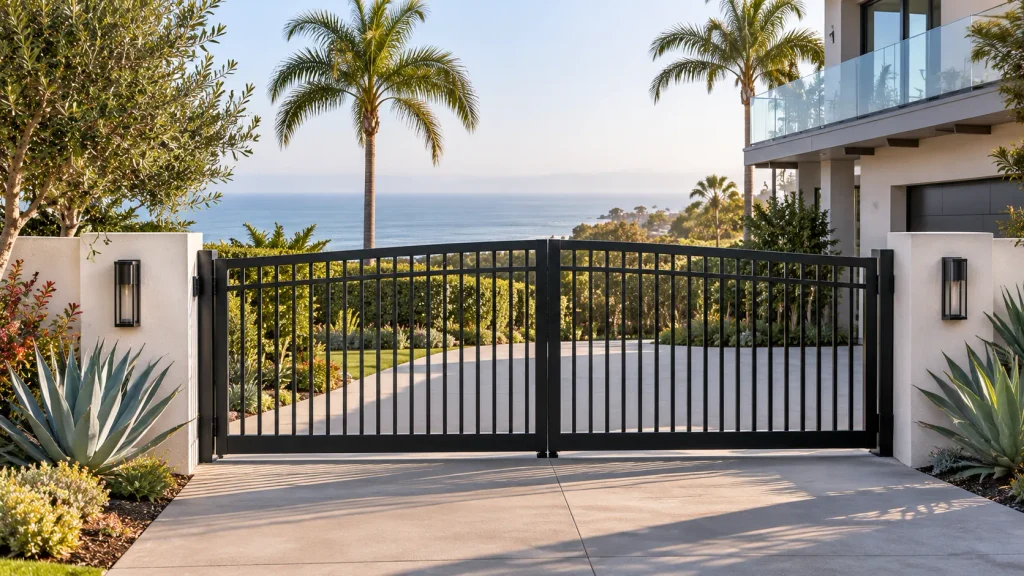
The best way to protect metal gates from coastal corrosion is to choose the right metal, hot-dip galvanize steel before powder coating it, and prepare every surface by sandblasting. Drained and sealed tubing, 316 stainless hardware, monthly freshwater rinses, and quick touch-ups finish the job. Each step is explained below with real corrosion data and a simple upkeep schedule.
Coastal Corrosion by the Numbers
Corrosion is one of the costliest problems in the built world. Hempel, a global coatings maker, estimates its yearly cost at 3 to 4% of global GDP.
Salt speeds the damage more than anything else. Under the ISO 9223 standard, bare carbon steel in a high-salinity coastal zone (category C5) can lose 80 to 200 microns of thickness in its first year. In the extreme CX category found at some surf beaches, steel loss climbs to 200 to 700 microns, while zinc loses only 8.4 to 25 microns.
That gap explains why zinc coatings work so well by the sea. The American Galvanizers Association reports that hot-dip galvanizing commonly keeps base steel free of corrosion for 50 to 75 years in most atmospheres, with a service life of more than 50 years in marine air.
Why Salt Air Attacks Metal Gates So Fast
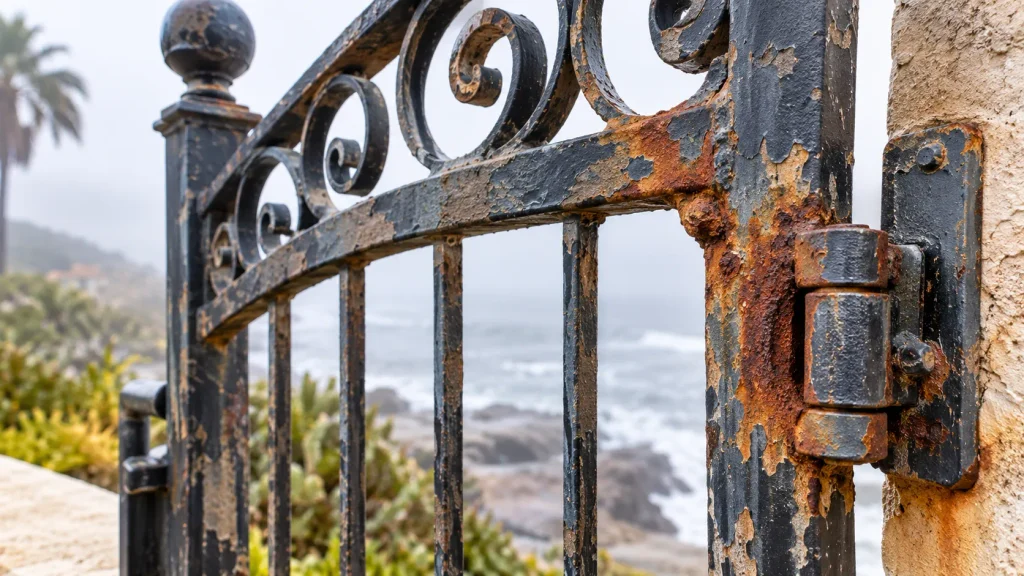
Coastal rust is not bad luck. It comes from a steady supply of salt, moisture, and oxygen meeting bare metal, and San Diego’s coastline delivers all three almost every day.
How Chloride Breaks Down Steel
Ocean waves throw tiny salt particles into the air, and onshore breezes carry them inland. When those particles land on a gate, they pull moisture from the air and form a thin salty film. Chloride ions in that film break through steel’s natural surface layer and speed up rusting.
The local marine layer makes it worse. Foggy mornings in late spring and early summer keep surfaces damp for hours, so the salt stays active longer. Sheltered spots under rails and behind hinges suffer most, because rain never rinses them clean.
How Distance From the Ocean Changes the Risk
Salt exposure drops quickly as you move inland. Researchers at the U.S. Naval Research Laboratory found that corrosivity is worst right at the surf zone and falls rapidly over the first few hundred meters. Homes in beach communities such as Coronado, Pacific Beach, La Jolla, Del Mar, Encinitas, and Oceanside face the heaviest exposure.
Risk does not vanish a mile from the water, though. Steady sea breezes and the marine layer carry salt well inland, so gates several miles from the coast still need real protection. The table below matches common distances to a sensible gate build.
| Distance From the Ocean | Salt Exposure | Recommended Gate Build | Recommended Hardware |
|---|---|---|---|
| Beachfront to about 1/4 mile | Extreme | Hot-dip galvanized steel plus powder coat, or aluminum with an AAMA 2605 finish | 316 stainless steel |
| 1/4 mile to 1 mile | Very high | Hot-dip galvanized steel plus powder coat | 316 stainless steel |
| 1 to 5 miles | High | Galvanized plus powder coat, or sandblasted and primed steel with powder coat | 316 stainless steel |
| 5 to 10 miles | Moderate | Sandblasted, primed, and powder-coated steel or aluminum | 316 preferred |
| Beyond 10 miles | Low from salt | Powder-coated steel or aluminum | 304 stainless or hot-dip galvanized |
These bands are a general guide, not a code requirement. Wind direction, hills, and how open a lot is to the sea can push a site up or down one level.
Choosing the Right Metal for a Coastal Gate
The metal under the finish sets the ceiling for how long a gate can last by the sea. Each common gate metal handles salt in a different way.
Hot-Dip Galvanized Steel
Hot-dip galvanizing dips finished steel into molten zinc, which bonds to the surface as a tough metal layer. The zinc shields the steel like a barrier. It also corrodes first, so small scratches stay protected instead of rusting.
This makes galvanized steel the strongest value for driveway and walk gates near the coast. The ASTM A123 standard sets minimum zinc thickness for this process. Steel gives the strength large swing and sliding gates need, while the zinc handles the salt.
Wrought Iron and Ornamental Steel
Most modern “wrought iron” gates are actually mild steel shaped into scrolls, pickets, and finials. That detail work looks beautiful, but every curl and joint creates a crevice where salt and water collect.
Ornamental gates near the ocean need full sandblasting and a heavy coating system, ideally over galvanizing. Without it, rust starts in the joints and spreads under the paint. The wrought iron lifespan depends far more on this protection than on the metal itself.
Aluminum
Aluminum contains no iron, so it never forms red rust. It builds a thin oxide layer that slows corrosion, though salt can still cause pitting on bare or poorly finished surfaces.
For coastal homes, choose aluminum with a tested architectural finish. AAMA 2604 coatings must survive 3,000 hours of salt spray testing, and AAMA 2605 coatings must survive 4,000 hours. Aluminum is lighter than steel, which suits pedestrian gates, though very large driveway gates often need steel framing for stiffness.
Stainless Steel
Stainless steel resists rust because chromium forms a self-healing surface film. Grade matters near the ocean. Type 316 contains 2 to 3% molybdenum, which blocks the chloride pitting that stains and weakens Type 304.
The International Molybdenum Association notes that Type 316 is often the most cost-effective choice within five to ten miles of a large saltwater body. Full stainless gates cost far more than other options, so 316 is most often used for hinges, latches, and fasteners.
Comparing Coatings That Protect Gates by the Sea
A gate’s finish is its first line of defense against salt. The table below compares the most common options, from basic paint to a full duplex system.
| Protection Method | How It Works | Expected Performance | Upkeep Level |
|---|---|---|---|
| Wet paint over bare steel | Thin barrier only | Recoat every 2 to 4 years | High |
| Sandblasting plus powder coat | Thick, oven-cured barrier with strong grip | 15 to 20 years or more with proper prep | Low |
| Hot-dip galvanizing | Zinc barrier plus sacrificial protection | More than 50 years of service life in marine air | Very low |
| Galvanizing plus powder coat (duplex) | Both layers protect each other | 1.5 to 2.3 times the combined life of both coatings | Lowest |
| AAMA 2604 or 2605 finish on aluminum | Tested high-performance coating | Passes 3,000 or 4,000 hours of salt spray | Low |
Paint and powder coat figures reflect typical results for properly prepared steel. Galvanizing and duplex figures come from American Galvanizers Association data.
Why Galvanizing Plus Powder Coating Works Best
A duplex system pairs hot-dip galvanizing with a powder coat on top. The powder coat seals the zinc from salt and moisture, so the zinc wears away far more slowly. If the topcoat gets chipped, the zinc underneath keeps the steel from rusting.
According to the American Galvanizers Association, this pairing lasts 1.5 to 2.3 times the sum of each coating’s life on its own. The lower 1.5 factor applies to salty, humid places like the coast, which still makes duplex the longest-lasting choice for a beach-area gate.
Surface Prep Makes or Breaks the Finish
No coating can outlast poor preparation. Bare steel carries mill scale, oil, and early rust that stop any finish from bonding. Powder coating over rust simply traps it underneath, where it keeps spreading.
At our Santee shop, gates are sandblasted with angular grit to remove every trace of scale and rust. Blasting also creates a rough anchor profile that the powder grips tightly. The sandblasting and powder coating process then cures the finish in an oven at about 400°F, and owners can choose from more than 150 colors.
Design Details That Stop Rust Before It Starts
Good coatings fail early on badly designed gates. These build details keep water and salt from settling where a finish cannot reach.
Drain and Seal Hollow Tubing
Most gate frames are built from hollow steel tube. If water gets inside and cannot escape, the tube rusts from the inside out, often for years before anyone sees it.
Small drain holes at the lowest points let moisture escape, while welded caps keep salt spray out of open tube ends. Galvanized frames also need vent holes so molten zinc can coat the inside of each tube. These details cost little during fabrication but are hard to add after a gate is finished.
Keep Dissimilar Metals Apart
When two different metals touch in salty moisture, one corrodes faster to protect the other. This is called galvanic corrosion, and salt water makes it much stronger.
Common trouble spots include steel screws in aluminum gates and brass or copper parts touching steel. Matching fastener metals to the gate, or adding nylon or neoprene washers between them, breaks the connection. Railing makers have reported this kind of damage where stainless cables meet aluminum posts in salt air.
Use Marine-Grade Hinges, Latches, and Fasteners
Hardware is usually the first part of a coastal gate to fail. Cheap zinc-plated hinges and latches carry only a thin coating that salt wears through quickly.
Type 316 stainless steel hinges, latches, and bolts hold up far longer near the ocean. Hinges with sealed bearings keep salt grit out of the moving parts. For gates with heavy daily use, rollers and track hardware should also be stainless or galvanized.
A Coastal Gate Maintenance Schedule
Even the best gate needs simple care near the sea. Rinsing off salt before it builds up is the single cheapest way to add years to any finish.
| Task | How Often | Why It Matters |
|---|---|---|
| Freshwater rinse, including under rails and hinges | Monthly; every two weeks within 1/4 mile of the surf | Removes salt before it draws in moisture |
| Wash with mild soap and a soft brush | Every 3 months | Lifts the salt film and grime a hose leaves behind |
| Inspect welds, hinges, and bottom rails | Twice a year | Catches chips and bubbling while they are small |
| Touch up chips and scratches | Within two weeks of finding them | Stops rust from creeping under the coating |
| Lubricate hinges, rollers, and latches | Every 3 to 6 months | Keeps moving parts free and quiet |
| Service the gate opener | Once a year | Protects the motor, circuit board, and sensors |
Skip pressure washers set to high power and harsh cleaners. Both can scar powder coat and open a path for salt.
Touching Up Chips Before They Spread
A small chip in a coastal gate finish can turn into a rust bubble within months. Fixing it early takes only a few minutes.
Clean the spot, remove any loose rust with a wire brush, and wipe it dry. Apply a zinc-rich primer, then finish with a color-matched touch-up paint. Large areas of bubbling or peeling need full shop refinishing, since spot repairs cannot reach rust that has spread under the coating.
Protecting Automatic Gate Openers
Salt air harms gate motors and electronics as much as the gate itself. Moisture from the marine layer can corrode circuit boards, wire terminals, and photo-eye sensors.
Choose openers with sealed, corrosion-resistant housings and stainless fasteners, and keep control boxes off the ground. Yearly service and these gate opener maintenance habits catch corrosion before it causes a breakdown.
When a Rusted Gate Needs Refinishing or Replacement
Light surface rust and chipped paint can usually be fixed with sandblasting and a new coating. Deep pitting, flaking scale, or holes in bottom rails and hinge posts mean the metal itself has thinned.
A gate with structural metal loss should be rebuilt or replaced, because it may sag or fail under its own weight. A shop that both fabricates and refinishes can judge whether the frame is still sound before any money goes into a new finish.
Common Questions About Coastal Gate Corrosion
Does powder coating stop rust near the ocean?
Powder coating stops rust well when it goes over sandblasted, rust-free steel. On its own, a chip lets salt reach bare metal and rust can spread underneath. Putting powder coat over hot-dip galvanizing gives far longer protection by the sea.
Is aluminum or galvanized steel better for a beach house gate?
Aluminum never forms red rust and suits lighter walk gates with an AAMA 2604 or 2605 finish. Galvanized steel with powder coat is stronger and better for large driveway gates and heavy automated systems. Both work well near the coast when finished properly.
How often should a coastal metal gate be rinsed?
A monthly freshwater rinse is a good baseline for most coastal homes. Gates within about a quarter mile of the surf benefit from a rinse every two weeks. Focus on sheltered spots under rails and around hinges, where rain never washes salt away.
Can rust on a coastal gate simply be painted over?
Painting over rust only hides it for a short time. Salt and moisture trapped underneath keep eating the steel, and the new paint soon bubbles and peels. Lasting repairs need the rust removed by sandblasting or wire brushing, then a primer and topcoat.
How far inland does salt air cause corrosion?
Salt exposure is strongest at the surf line and drops quickly over the first few hundred meters. Breezes and fog still carry salt several miles inland, and stainless steel experts recommend marine-grade 316 hardware within five to ten miles of the sea.
Conclusion
Salt air will always test a metal gate near the coast. The difference between a gate that rusts in a few seasons and one that lasts decades comes down to choices made before it is ever installed. Smart upkeep then keeps that protection working.
Galvanized steel or finished aluminum gives the best starting point. A duplex system of galvanizing and powder coat over a sandblasted surface delivers the longest life, while drained tubing and 316 stainless hardware close the weak spots. Monthly rinses and quick touch-ups handle the rest, which is all it takes to protect metal gates from coastal corrosion for years.
Fred’s Fencing Inc. has fabricated gates in our 12,000-square-foot Santee shop since 1984, with sandblasting and powder coating done in-house. Contact Fred’s Fencing Inc. today for custom metal gates built to stand up to San Diego’s coastal air.