Coyote Proof Fencing: How to Keep Coyotes Out of Your San Diego Yard
Coyote Proof Fencing: How to Keep Coyotes Out of Your San Diego Yard
Height, anti-climb toppers, and dig barriers — the three elements that stop a coyote from jumping, climbing, or digging into your property.
Coyotes in San Diego Are Not Going Away
Coyotes now live in 49 of the 50 U.S. states. In San Diego County, they are a permanent and expanding part of the urban landscape — not a temporary nuisance. The San Diego Humane Society, which manages animal control for most cities in the county, has reported a consistent increase in coyote sighting reports, climbing from 2–3 calls per week to 4–5 per week in recent tracking periods. University of California Agriculture and Natural Resources mapped sightings in 2024 across the full county — from Oceanside in the north to Otay Mesa at the Mexican border, from the La Jolla and Encinitas coastline to Santee, El Cajon, and Escondido inland.
These are not occasional visitors. San Diego coyotes are year-round residents. Pupping season (April through June) and breeding season (January through March) increase daytime sightings as coyotes expand their territory to establish den sites, but they remain active and present in every month of the year.
Why Standard Backyard Fences Fail
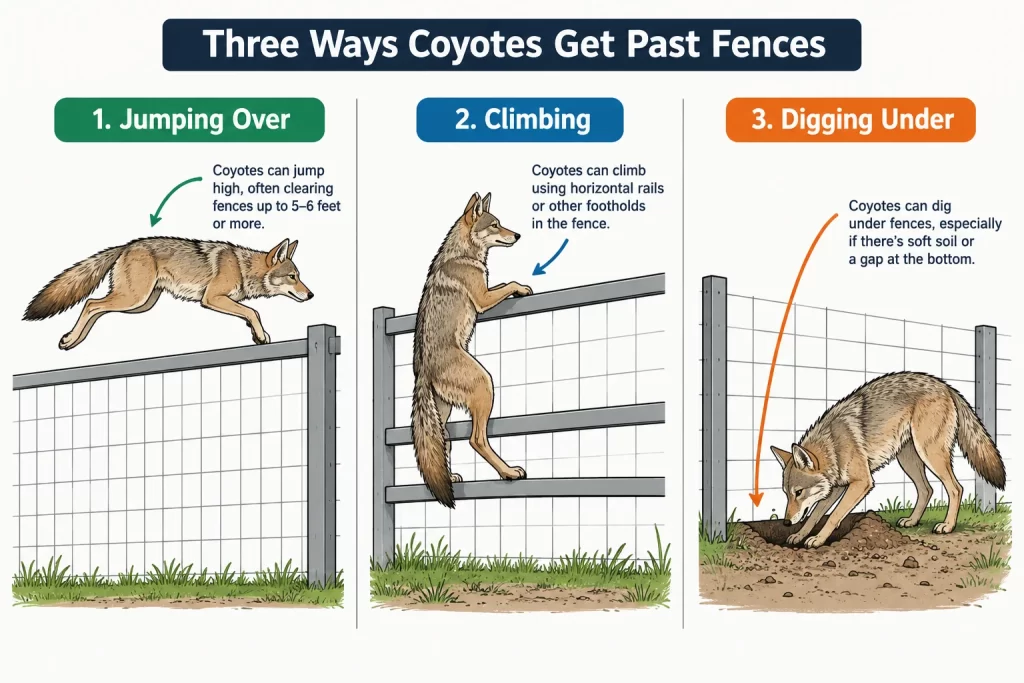
A coyote can scale a 6-foot fence in just over one second. The motion looks like a clean jump, but it is actually a two-phase move: the coyote leaps to grab the top of the fence with its front paws, then pulls itself upward to gain the remaining height. Any fence with a rigid, graspable top edge — wood, vinyl, iron, chain link — gives a coyote exactly what it needs to complete that second phase.
Standard residential fences in San Diego are typically 6 feet tall. That height alone does not stop a motivated coyote. To stop one, a fence must address all three entry methods:
Jumping — a coyote can clear a 5-foot barrier outright and use a two-phase grip-and-pull to top a 6-foot fence. Climbing — chain link diamond mesh, horizontal fence rails, and decorative ironwork all provide footholds. Digging — coyotes can excavate under a fence in minutes, particularly in San Diego’s sandy and decomposed granite soils.
A true coyote-proof fence addresses all three simultaneously. Fail on any one, and the fence is just an obstacle, not a barrier.
What Makes a Fence Coyote Proof
A coyote proof fence is not a single product — it is a combination of height, anti climb treatment, and underground barrier working together. Remove any one element and the system has a gap.
Height: 6 Feet Minimum, 7-8 Feet Recommended
Most wildlife management agencies recommend a minimum fence height of 6 feet for coyote deterrence. The Humane Society of the United States, the San Diego Humane Society, and the San Diego County Department of Animal Services all reference 6 feet as the baseline. However, 7 to 8 feet provides a significantly higher margin of safety, particularly in areas with dense coyote populations or where the fence sits near a natural launching surface — a hillside, a retaining wall, a raised planter bed — that gives the coyote an elevated starting point.
In the City of San Diego, residential fences up to 6 feet are allowed in side and rear yards without a construction permit. Fences above 6 feet require a building permit. The code does allow up to 9 feet total height if everything above 6 feet is open — lattice, wire extension, or roller systems. This code provision aligns well with coyote-proofing needs: a 6-foot solid fence with a 1 to 2-foot wire or roller extension on top reaches 7–8 feet total within San Diego’s permit framework.
Anti Climb Toppers: Coyote Rollers, Angled Extensions, and Wire Overhangs
The top of the fence is the critical failure point. A coyote does not leap clear over a 6-foot fence — it grabs the top and pulls itself over. If the top of the fence denies that grip, the coyote cannot complete the climb.
Three topper types work:
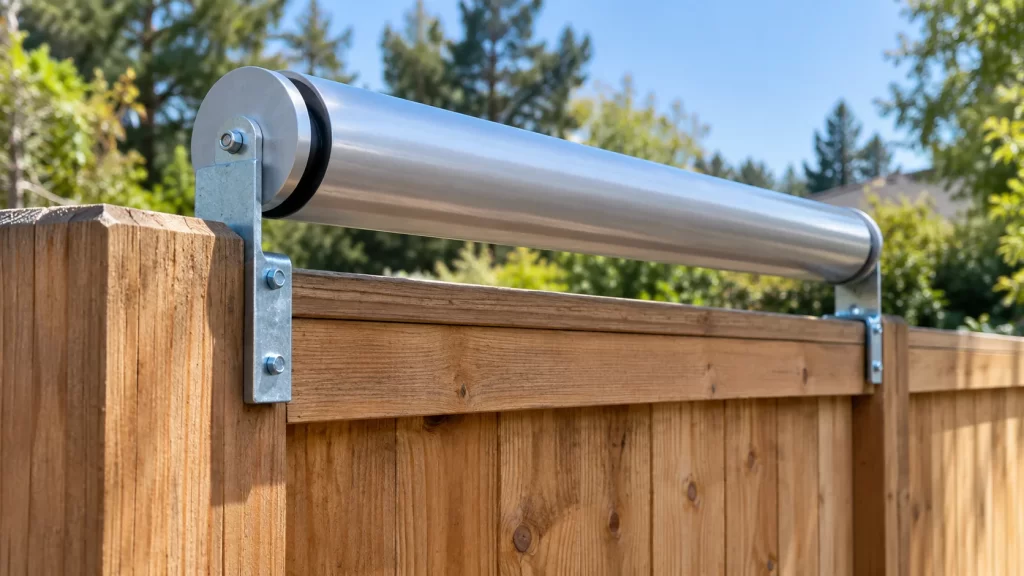
Coyote rollers are aluminum or PVC cylinders mounted on brackets along the top of the fence. When a coyote grabs the roller, it spins freely — no traction, no grip, no way to pull upward. Rollers are the most popular retrofit option because they install onto existing fences without replacing the fence itself. A 100-foot coyote roller kit — enough for a typical San Diego backyard — runs approximately $850 to $900 for materials. Professional installation adds $300 to $800 depending on fence type and access. Rollers are available in colors that match common fence materials (black, brown, tan, white), and they work on wood, vinyl, iron, chain link, and composite fences.
Angled extensions are wire or mesh panels attached to the top of the fence and angled outward at 45 degrees. When a coyote reaches the top of the vertical fence and encounters an angled surface leaning away, it cannot maintain balance to continue climbing. The extension typically adds 12 to 18 inches of additional barrier at the outward angle. This method is common on agricultural properties and is one of the designs referenced in USDA Wildlife Services predator management guidelines.
Wire overhangs function like angled extensions but use tensioned wire strands instead of mesh panels. Three to four horizontal wires at 4-inch spacing, angled outward 45 degrees from the fence top, create a barrier that a coyote’s body weight cannot push past. This is the lowest-cost topper option and is particularly effective on chain link fences where post tops can be bent outward to support the wire.
Anti Dig Barriers: L-Footer, Concrete Footer, and Buried Mesh
Coyotes dig fast. San Diego’s soil conditions — decomposed granite in East County, sandy loam along the coast, clay in inland valleys — vary across the county, but none present a significant obstacle to a digging coyote. If the fence stops a coyote from going over, it will try going under.
Three dig-prevention methods work:
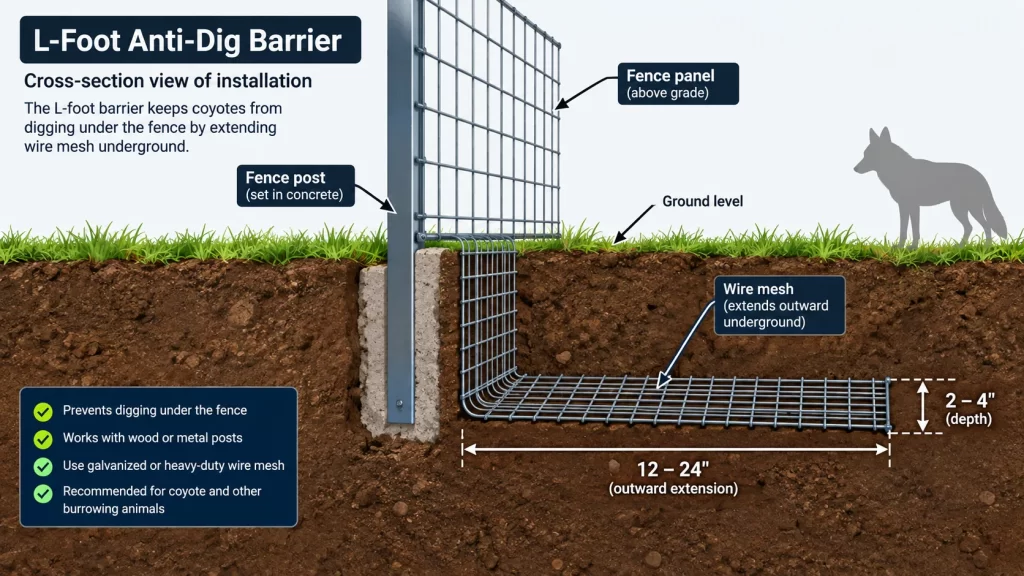
L foot wire mesh is the most widely used anti-dig barrier. Galvanized hardware cloth or welded wire (14-gauge minimum, 2×4-inch mesh or smaller) is attached to the bottom of the fence and extends 12 to 24 inches outward underground in an L-shape. When a coyote digs at the fence base, it hits wire within the first few inches and cannot dig past. The L-footer can be buried 2 to 4 inches below grade and covered with soil, mulch, or gravel so it is invisible from the surface. Cost for materials is approximately $1 to $3 per linear foot for the wire mesh plus stakes.
Concrete footer is the most permanent solution. A concrete strip 4 to 6 inches deep and 12 inches wide is poured along the base of the fence. No animal can dig through cured concrete. This method is common on new fence installations where the concrete can be poured during post setting. Retrofitting a concrete footer onto an existing fence is more labor-intensive but delivers a permanent anti-dig barrier. Cost for a poured concrete footer runs $5 to $15 per linear foot depending on width and site access.
Buried fence mesh extends the fence material itself 12 to 18 inches below grade. This is standard practice for chain link fence installations in coyote-active areas — the same mesh that forms the fence body continues underground, creating a continuous barrier from above grade to below.
Best Fence Materials for Coyote Proofing
Not every material performs equally against coyotes. The best choice depends on your budget, your property’s aesthetics, and which coyote entry methods are most relevant to your location.
Chain Link
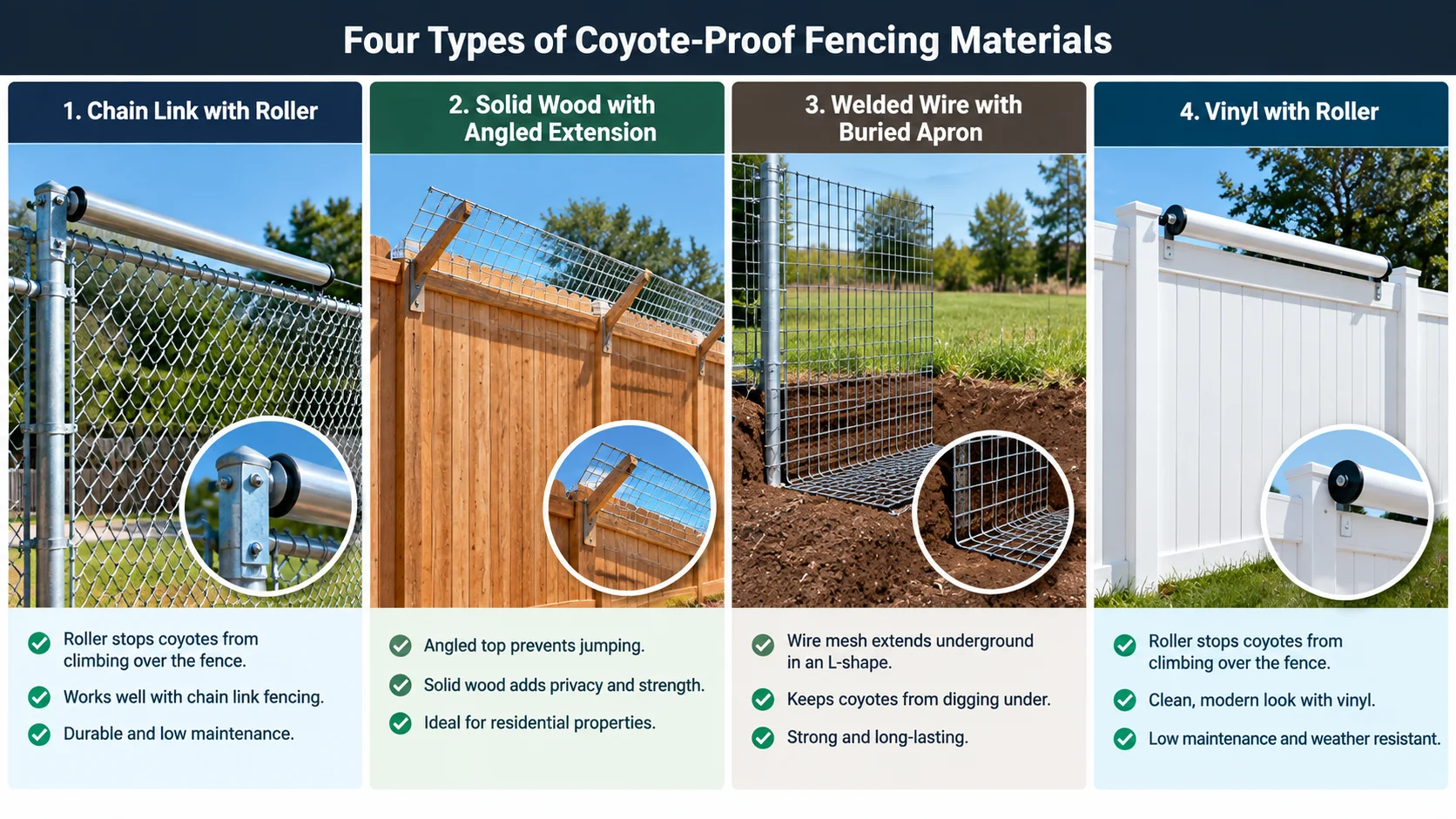
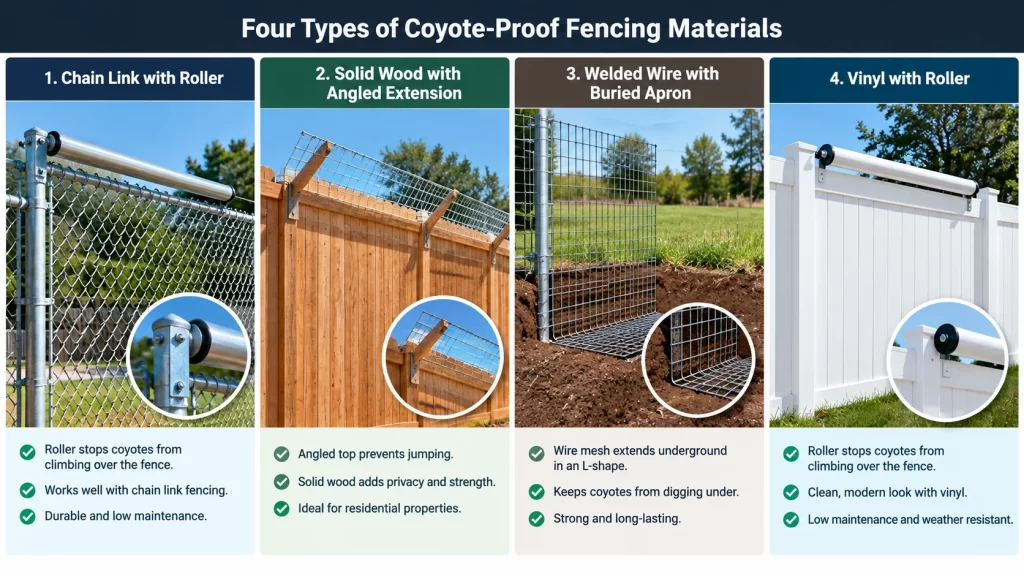
Chain link is the most common material for dedicated predator-exclusion fencing. Its steel construction is impossible for coyotes to chew through, and it accepts rollers, angled extensions, and buried mesh without modification. The limitation is climbability — standard chain link diamond mesh provides excellent footholds for a climbing coyote. For chain link to function as coyote-proof fencing, it must be paired with an anti-climb topper. Standard 6-foot galvanized chain link costs $10 to $25 per linear foot installed. Adding a roller system brings the total to $20 to $35 per linear foot.
Solid Wood Privacy Fencing
A 6-foot solid wood privacy fence eliminates footholds by presenting a smooth vertical surface with no horizontal rails on the exterior face. This is an advantage over chain link — a coyote cannot climb a flat surface the way it can climb a mesh grid. The vulnerability is at the top: a coyote can still grab the top edge and pull over. Adding rollers or an angled extension to a wood fence makes it highly effective against coyotes. Wood fencing with a coyote-proof topper costs $25 to $55 per linear foot installed, plus $8 to $10 per foot for roller hardware.
Vinyl Privacy Fencing
Vinyl offers the same smooth, unclimbable surface as solid wood but requires no maintenance and does not rot, warp, or splinter. A 6-foot solid vinyl fence with a roller system on top is one of the cleanest-looking coyote deterrent configurations available. The smooth PVC surface is harder for a coyote to grip than raw wood, adding a marginal advantage. Vinyl fencing costs $28 to $55 per linear foot installed.
Welded Wire Mesh
Welded wire with small mesh openings (2×4 inches or smaller) and 14-gauge or heavier wire is the standard for agricultural and rural coyote exclusion. It prevents squeezing through, is difficult to climb when mesh is small, and integrates easily with buried aprons and L-footers. Welded wire is the most affordable option for large-perimeter properties — ranches, hobby farms, and horse properties in East County communities like Ramona, Valley Center, Jamul, and Alpine. Cost runs $3 to $10 per linear foot for materials, depending on wire gauge and mesh size.
Electric Fencing
Electric fencing is used primarily on livestock operations. A low-impedance charger delivering 4,000 to 5,000 volts through alternating charged and ground wires creates a psychological barrier — the coyote learns after one contact that the fence is painful to touch. Research published by the Journal of Range Management found that properly designed electric fencing was “coyote proof” under tested conditions. Electric fencing for coyote exclusion typically uses 7 to 11 wire strands at 4 to 6-inch vertical spacing. The cost for materials and charger runs $1.50 to $7.00 per linear foot, though San Diego municipal code restricts electric fencing in residential zones — check local regulations before considering this option.
Coyote Proof Fence Installation: 7 Steps
Step 1 — Assess Your Property for Coyote Entry Points
Walk the full perimeter. Look for gaps under existing fences, low spots where the fence dips below 6 feet, gate clearances wider than 4 inches, and any horizontal surface — a retaining wall, a utility box, a woodpile — within 8 feet of the fence that gives a coyote an elevated launch point.
Step 2 — Check San Diego Fence Height Regulations
In the City of San Diego, fences up to 6 feet in side and rear yards do not require a permit. Extensions above 6 feet that use open material (wire, rollers, lattice) can reach 9 feet total. If your plan exceeds these limits, a building permit is required. Unincorporated county areas follow different rules — check with the San Diego County Department of Planning and Development Services.
Step 3 — Choose Your Fence Material
Match the material to your property type. Residential yards in suburban San Diego neighborhoods typically use solid wood, vinyl, or chain link with a roller topper. Rural properties in East County and North County often use welded wire or chain link with angled extensions. Coastal properties should use materials rated for salt-air exposure.
Step 4 — Set Posts Deep and Secure
Fence posts should be set at least 24 to 36 inches deep in concrete footings. Deeper post settings — 36 to 42 inches — are recommended for fences taller than 6 feet and for properties in San Diego’s softer sandy soils. Post spacing of 6 to 8 feet is standard.
Step 5 — Install the Fence Material With Zero Gaps
Attach the fence tightly between posts. No gap larger than 4 inches should exist anywhere along the fence line — at the bottom, at the sides, between panels, or at posts. A coyote can squeeze through any opening wider than 4 inches. Juvenile coyotes can fit through even smaller gaps.
Step 6 — Install the Anti-Dig Barrier
Bury wire mesh in an L-foot configuration extending 12 to 24 inches outward from the fence base, or pour a concrete footer if budget allows. This step is non-negotiable — a fence without dig protection is a fence with a hole waiting to happen.
Step 7 — Add the Anti-Climb Topper
Install coyote rollers, an angled wire extension, or wire overhang along the entire top of the fence. Do not leave gaps at corners, gate posts, or where the fence meets a structure. Coyotes exploit any unprotected section.
Get Coyote Proof Fence Installed
Coyote Proofing Your Existing Fence
You do not always need a new fence. Many existing San Diego residential fences can be upgraded to coyote-proof status with targeted modifications.
Retrofit Checklist for Existing Fences
Is the fence at least 6 feet tall at every point? If not, add height extensions. Are there gaps under the fence wider than 2 inches? If so, install an L-foot wire barrier. Does the fence have horizontal rails, decorative elements, or mesh openings that provide footholds? If so, add a roller or angled extension to neutralize climbing at the top. Are gates secure? Gates are the weakest point in any fence. Install self-closing hardware, reduce ground clearance to under 2 inches, and add a roller above the gate if height permits.
A coyote roller retrofit on an existing 150-foot fence perimeter (a typical San Diego backyard) costs approximately $1,300 to $1,800 for materials or $2,000 to $3,000 professionally installed. Adding an L-foot dig barrier adds $150 to $450 in wire mesh and hardware. Total retrofit cost for a standard residential property ranges from $1,500 to $3,500 — significantly less than replacing the entire fence.
H2: San Diego Neighborhoods With the Highest Coyote Activity
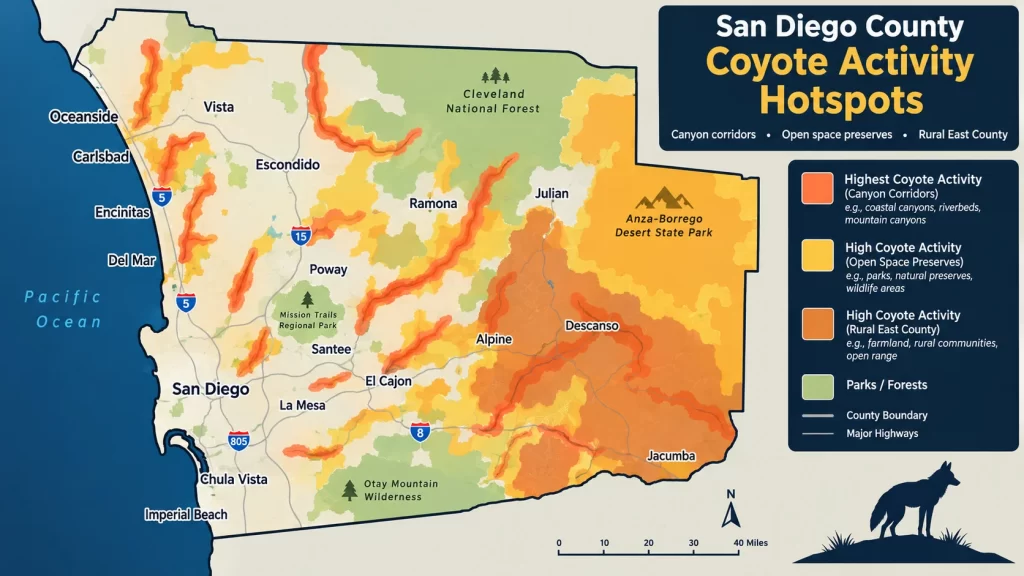
Coyote encounters are reported countywide, but certain neighborhoods and landscape features concentrate activity.
Properties bordering canyons — Mission Hills, Hillcrest, Tierrasanta, Scripps Ranch, Carmel Valley, Mira Mesa — are in direct contact with coyote travel corridors. Canyon systems function as highways for wildlife, and homes along canyon rims are the first properties coyotes encounter when leaving natural habitat.
Properties near open space preserves and undeveloped land — Santee, Lakeside, Ramona, Poway, Alpine, Rancho Peñasquitos — share boundaries with habitat that supports established coyote populations year-round.
Coastal neighborhoods — La Jolla, Del Mar, Encinitas, Pacific Beach, Ocean Beach — have also reported increasing sightings as coyotes adapt to the coastal urban environment. NBC 7 San Diego reported increased coyote encounters across the county in mid-2026, noting that these animals are “a year-round part of San Diego’s ecosystem.”
If you live near any of these landscape features, proactive coyote-proofing is a stronger strategy than waiting for a sighting or an incident.
Additional Deterrents That Complement Coyote-Proof Fencing
A fence is the primary barrier, but combining it with behavioral deterrents reduces the chance of a coyote even approaching your fence line.
Remove Attractants Bring pet food bowls inside at dusk. Secure garbage cans with locking lids. Pick up fallen fruit from trees. Remove bird feeders (they attract rodents, which attract coyotes). The Wildlife Conservation Society has found that removing food sources reduces coyote encounters in urban areas by up to 60%.
Install Motion-Activated Lighting and Sprinklers Sudden bright light or a spray of water startles coyotes and creates a negative association with your property. Position motion sensors along the fence line and at gate entries. Solar-powered units work well in San Diego’s climate.
Practice Coyote Hazing The San Diego County Department of Animal Services recommends hazing — yelling, waving arms, maintaining eye contact, stomping feet — as a technique to reinforce coyote fear of humans. A hazed coyote learns to avoid your property. A coyote that is ignored or inadvertently fed learns the opposite.
Supervise Small Pets at Dawn and Dusk Coyotes are crepuscular — most active at dawn and dusk. Small dogs, cats, and chickens should not be left unattended outdoors during these hours, even behind a fence. A fence is a deterrent, not a guarantee.
Is Coyote Proof Fencing Humane?
Yes. Fencing is one of the most humane wildlife management methods available. It prevents conflict without trapping, poisoning, or killing. The San Diego Humane Society explicitly recommends fencing as a responsible coexistence strategy. Trapping and relocating coyotes is not recommended by wildlife agencies — the San Diego Humane Society notes that removed coyotes are simply replaced by others from neighboring territories, and research confirms that lethal management does not reduce overall coyote populations.
A coyote-proof fence allows coyotes to continue living in their natural habitat while keeping your property, pets, and family safe. The University of Minnesota found that properties with secure fencing (6+ feet with anti-climb treatment) experience a 75% reduction in coyote encounters compared to unfenced or inadequately fenced properties.
What Does Coyote Proof Fencing Cost?
Costs vary based on fence type, property size, and whether you are building new or retrofitting an existing fence.
New Coyote-Proof Fence Installation
Chain link (6 ft) with roller and buried mesh: $20 to $40 per linear foot installed. Solid wood (6 ft) with roller and L-foot barrier: $35 to $65 per linear foot installed. Vinyl (6 ft) with roller and dig guard: $35 to $65 per linear foot installed. Welded wire (7.5 ft) with buried apron: $5 to $15 per linear foot installed.
For a typical San Diego residential backyard with 150 linear feet of fencing, expect $3,000 to $9,750 for a complete coyote-proof installation depending on material.
Retrofit of Existing Fence
Coyote roller system (150 ft): $1,300 to $3,000 installed. L-foot wire barrier (150 ft): $150 to $450 for materials. Gate reinforcement: $200 to $600 depending on gate type.
Total retrofit: $1,500 to $3,500 for a typical residential property.
Frequently Asked Questions
How tall should a coyote-proof fence be?
At least 6 feet with an anti-climb topper (roller, angled extension, or wire overhang) bringing the effective height to 7–8 feet. A 6-foot fence alone is not coyote-proof — the topper is what makes the difference.
Can coyotes jump a 6-foot fence?
Yes. A coyote can top a 6-foot fence using a two-phase grip-and-pull in about one second. The fence height slows the coyote, but the anti-climb topper is what prevents it from completing the climb.
Do coyote rollers actually work?
Yes, when properly installed on a fence that is at least 6 feet tall and paired with a dig barrier. Rollers are not a standalone solution — they address climbing only. A fence without dig protection and without adequate height will still fail even with rollers installed.
What is the best material for a coyote-proof fence?
For residential properties in San Diego, solid wood or vinyl with coyote rollers and an L-foot dig barrier provides the best combination of aesthetics, privacy, and coyote deterrence. For rural or large-perimeter properties, welded wire with a buried apron is the most cost-effective option.
Can a coyote dig under a fence?
Yes. Coyotes dig quickly, especially in loose soil. San Diego’s decomposed granite and sandy soils offer minimal resistance. An anti-dig barrier — buried wire mesh, concrete footer, or extended fence below grade — is essential for any coyote-proof fence.
How do I report a coyote sighting in San Diego?
Report sightings to the San Diego Humane Society or the Department of Wildlife Services at 1-800-486-0010. The Department of Animal Services can be reached at 619-236-2341.
Can Fred’s Fencing install coyote-proof modifications on my existing fence?
Yes. We retrofit existing fences with coyote rollers, anti-dig barriers, height extensions, and gate reinforcements across San Diego County. We also install new coyote-proof fencing in all materials — chain link, wood, vinyl, iron, and welded wire.