White Vinyl Fence Ideas for Front Yards and Backyards in San Diego
By the Fred’s Fencing Inc. team, San Diego County fence builders since 1984
Few upgrades change the look of a home as fast as a clean white fence line. White vinyl stays bright for decades, never needs paint, and suits both the street side and the private side of a property. The real skill lies in matching each style to the right yard.
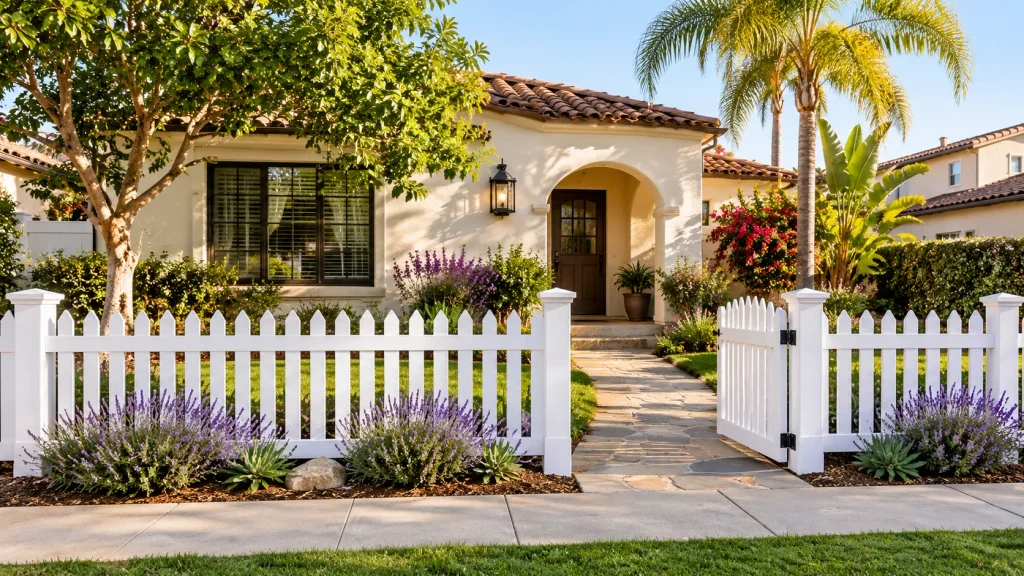
The best white vinyl fence ideas for front yards are straight pickets, scalloped pickets, Victorian designs, masonry pillar combos, ranch rails, and matching walk gates. For backyards, the top picks are solid 6-foot privacy panels, lattice tops, shadowbox panels, horizontal slats, pool barriers, and stepped panels for slopes. Each one is covered below with heights, costs, and San Diego rules.
White Vinyl Fencing by the Numbers in 2026
Vinyl is one of the steadiest growth stories in fencing. Intel Market Research valued the global vinyl fence market at about $2.22 billion in 2025, with North America as the largest region. It expects the market to reach about $2.91 billion by 2034, a 4.1% yearly growth rate.
Price is a big reason for that demand. National installed prices for vinyl average about $30 to $60 per linear foot in 2026. Short picket styles cost far less than tall privacy panels, and labor alone usually runs $5 to $13 per foot.
Lifespan seals the deal. Quality vinyl is commonly rated for 20 to 30 years, while many wood fences need replacing after 10 to 15. Wood also needs fresh stain every 2 to 3 years, which is why so many homeowners comparing wood versus vinyl end up choosing vinyl.
White Vinyl Fence Styles Compared at a Glance
Each style below does a different job, from framing a lawn to blocking a neighbor’s view. Use this table to narrow the list before reading the details.
| Style | Best Yard | Typical Height | Privacy Level | Installed Cost per Foot (2026, national) |
|---|---|---|---|---|
| Straight-top picket | Front | 3 ft (San Diego city), 3.5 ft (Santee, county) | Low | $18 to $30 |
| Scalloped or arched picket | Front | 3 ft (San Diego city), 3.5 ft (Santee, county) | Low | Picket range plus a small premium for curves |
| Victorian picket with post caps | Front | 3 ft (San Diego city), 3.5 ft (Santee, county) | Low | Picket range plus decorative caps |
| Pickets with masonry pillars | Front | 3 ft (San Diego city), 3.5 ft (Santee, county) | Low | Picket range plus pillar footings and masonry |
| Two-rail or three-rail ranch | Front, large lots | 3 ft (San Diego city), 3.5 ft (Santee, county) | Very low | $14 to $25 |
| Picket fence with matching walk gate | Front | Matches fence | Low | Fence price plus gate |
| Solid tongue-and-groove privacy | Back | 6 ft | Full | $26 to $61 |
| Privacy with lattice top | Back | 6 ft (5 ft solid, 1 ft lattice) | High | $26 to $61 |
| Shadowbox or basketweave semi-privacy | Back, shared lines | 5 to 6 ft | Partial | $29 to $55 |
| Horizontal slats | Back | 6 ft | Full or partial | Privacy range |
| Pool barrier | Back | 60 in minimum | Varies | Picket or privacy range |
| Stepped panels on slopes | Back and side | 6 ft per step | Full | Privacy range plus grading |
Cost ranges reflect HomeGnome’s 2026 national vinyl pricing by style. San Diego labor rates often push quotes toward the top of each range, so treat these figures as starting points.
Front Yard White Vinyl Fence Ideas That Boost Curb Appeal
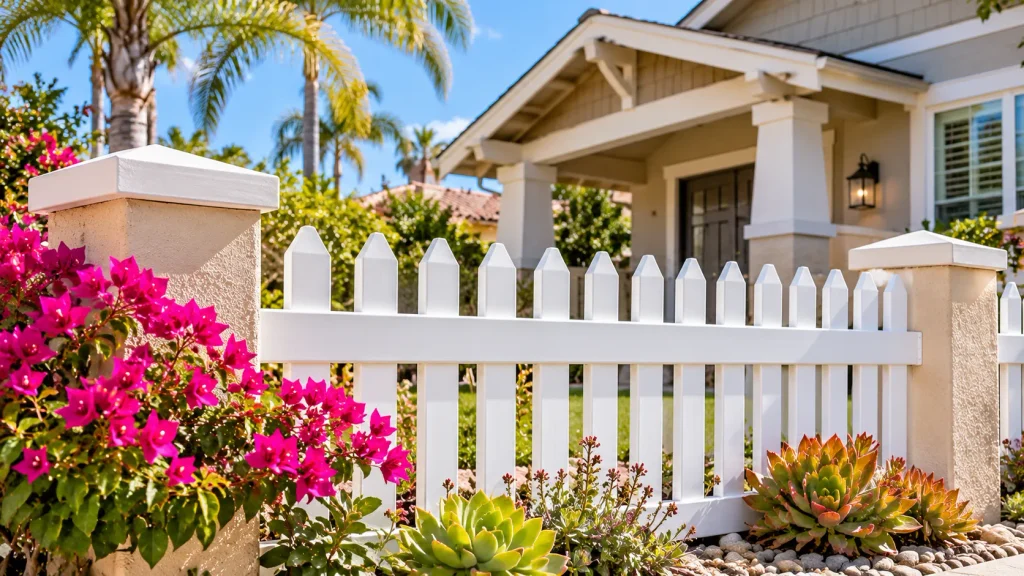
Front yard fences must stay low in most of San Diego County, so these ideas focus on style more than privacy. The City of San Diego caps front fences at 3 feet, while Santee and unincorporated county areas allow 3.5 feet. Each idea below works within those fence height rules.
A low fence still does real work. It guides visitors to the front door, keeps pets and kids close to the house, and gives garden beds a clean backdrop.
Classic Straight-Top Picket Fence
A straight-top picket fence is the classic front yard look. Evenly spaced pickets sit between two rails, so the yard stays open and friendly. It frames a lawn or flower bed without hiding the house.
Front yard pickets stand 3 feet tall inside the City of San Diego and up to 3.5 feet in Santee and county areas. Gaps of about 2 to 3 inches let light through while helping keep most pets inside. Pointed, flat, or dog-ear tops on each picket shift the mood from cottage to modern farmhouse.
Scalloped and Arched Picket Designs
Scalloped pickets dip low in the middle of each panel, creating a gentle wave along the street. Arched designs do the opposite, with the tallest picket in the center. Both add soft curves that pair well with Spanish Revival, Craftsman, and cottage homes.
These styles look best along a straight walkway or around a corner lot. Keep the highest point of each curve under your front yard limit, since height is measured to the top of the fence. Repeating the same curve on the walk gate ties the whole line together.
Victorian Pickets With Decorative Post Caps
Victorian vinyl fences use shaped pickets and ornate posts instead of plain square boards. Many styles add a spear, gothic, or ball top to each picket. The result looks like carved woodwork but never needs paint.
Post caps are an easy upgrade on any front fence. New England caps add a stepped, formal look, while solar caps light the walkway at night with no wiring. On a short fence, caps and posts become the details people notice first from the street.
White Pickets With Stone or Stucco Pillars
Pairing white pickets with masonry pillars gives a front yard a custom, high-end feel. Stone, brick, or stucco columns break long fence runs into neat sections. Stucco pillars painted to match the house blend well with the Mediterranean homes found across the region.
Pillars also make strong anchor points at driveways and walk gates. Each column needs its own footing, so this idea costs more than vinyl alone. Keep pillar tops close to the fence height so the whole project stays within front yard limits.
Two-Rail and Three-Rail Ranch Fencing
Ranch rail fencing uses two or three horizontal rails between posts with wide open space. It marks a property line without blocking views of the yard or the hills behind it. It suits large or rural lots where a long frontage needs a light, open border.
Split-rail and ranch styles are the lowest-cost vinyl options, at about $14 to $25 per foot installed in 2026. Three-rail designs feel sturdier and suit horse property. Adding wire mesh to the inside face keeps dogs from slipping between the rails.
Picket Fence With a Matching Walk Gate
A front fence feels complete when the walk gate matches the pickets. A 4-foot-wide gate fits most front paths and leaves room for a stroller or garden cart. Wider double gates work well where a path meets the driveway.
Gates carry more stress than fixed panels, so the build matters. At our Santee shop, every vinyl gate post gets an aluminum or steel insert, and gate frames are steel so they hold their shape. Our white vinyl gates come in walk, picket, privacy, double, and pool styles.
Backyard White Vinyl Fence Ideas for Privacy and Outdoor Living
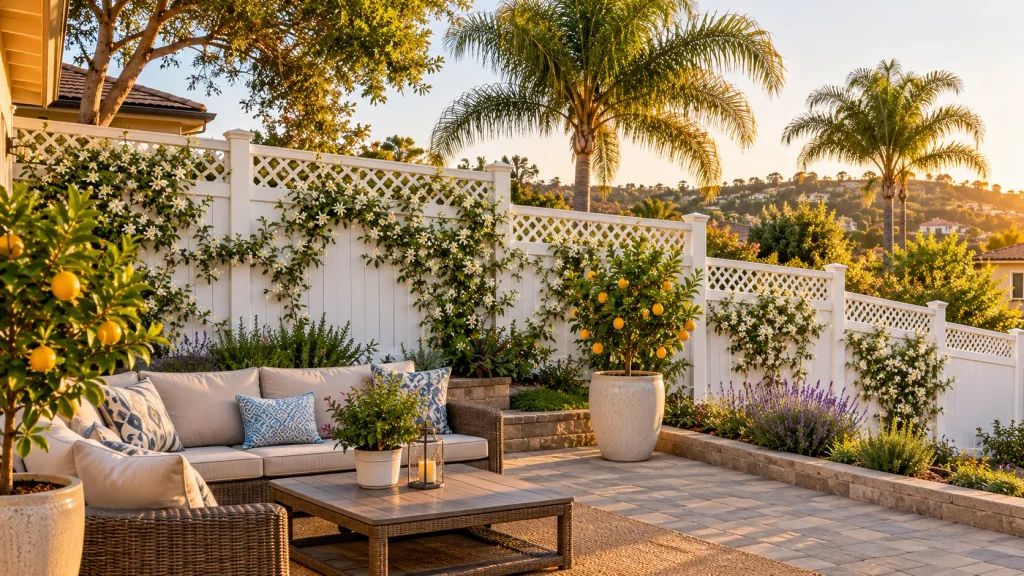
Backyards are where white vinyl does its heaviest work. Side and rear fences can usually reach 6 feet, which opens the door to full privacy designs.
These six ideas cover privacy, airflow, pools, and hillside lots. Each one balances how much the fence hides with how much light, breeze, and view it lets through.
Solid 6-Foot Privacy Panels
Solid privacy panels are the most popular backyard choice. Tongue-and-groove boards lock together with no gaps, so neighbors and passing cars cannot see in. Six feet is the standard height and matches the side and rear limit in most local codes.
A solid fence also helps with noise reduction along busy streets. Vinyl privacy fencing runs about $26 to $61 per foot installed in 2026. For a clean backyard retreat, this is the simplest and most complete option.
Privacy Fence With a Lattice Top
A lattice topper softens the top foot of a privacy fence. A common setup pairs a 5-foot solid panel with 1 foot of lattice above it. The fence still blocks views at eye level but feels lighter from the patio.
Lattice also works as a trellis. Star jasmine, bougainvillea, and climbing roses grow well in San Diego and weave easily through the openings. Square lattice looks crisp and modern, while diagonal lattice suits traditional and coastal homes.
Shadowbox and Semi-Privacy Panels
Semi-privacy fences let air pass through small gaps between boards. Shadowbox panels place pickets on alternating sides of the rail, so the fence looks good from both yards. That makes it a friendly choice for shared property lines.
Airflow matters in this region. Santa Ana winds can gust hard across inland San Diego County, and gapped designs ease that load on posts.
Basketweave panels give a similar two-sided look, with flat boards woven between the rails for extra texture. Expect 2026 installed prices of about $29 to $55 per foot for shadowbox styles.
Modern Horizontal White Slats
Horizontal slats give white vinyl a clean, modern look. Wide boards run sideways between posts, which makes a narrow yard feel wider. This style suits contemporary homes, mid-century ranches, and new builds with flat roof lines.
Slats can sit tight for full privacy or with small gaps for a lighter screen. Long horizontal boards can sag over wide spans, so posts often sit closer together than on vertical panels. Black or gray post caps add contrast if pure white feels too plain.
Vinyl Pool Barrier Fencing
White vinyl makes a clean, rust-free pool barrier. California’s Swimming Pool Safety Act sets the key numbers. The enclosure must stand at least 60 inches tall, leave no more than 2 inches at the ground, and block any gap a 4-inch sphere could pass through.
Gates must open away from the pool and close and latch on their own, with the latch at least 60 inches above the ground. Keeping horizontal rails on the pool side makes the outside face harder for children to climb. We install pool fencing built around these rules.
Stepped Panels for Sloped Yards
Many San Diego lots sit on hills, and a fence must follow that grade. Stepped installation sets each panel level, then drops it down at each post like a staircase. This keeps the top line neat and the panels square.
Steeper slopes leave triangle-shaped gaps under each step. Those gaps can be closed with landscape blocks or a short retaining edge so pets cannot slip out. Racked panels that tilt with the ground are another option on gentle grades.
Height Limits for White Vinyl Fences Across San Diego County
Height limits decide which ideas fit each yard. The rules change from city to city, so a picket height that works in one town may be too tall in the next.
| Area | Front Yard Limit | Side and Rear Limit | Key Detail |
|---|---|---|---|
| City of San Diego | 3 ft (solid or open) | 6 ft solid, up to 9 ft | Any part above 6 ft must be at least 35% open (75% in the Coastal Overlay Zone); visibility areas are capped at 3 ft |
| Unincorporated San Diego County | 42 in | 72 in | Applies within required setbacks |
| City of Santee | 3.5 ft | 6 ft | Front fences may reach 6 ft if the top 2.5 ft is at least 90% open |
| Pools, statewide | 60 in minimum | 60 in minimum | Self-closing, self-latching gates that open away from the pool |
The city limits come from San Diego’s fence bulletin, and the county limits from its fence guidelines. Homeowners’ associations often add their own rules on height, style, and color, so check your CC&Rs before ordering panels.
Stepping Down From Backyard Height to Front Yard Height
A side fence often runs 6 feet tall along the backyard, then has to drop to 3 or 3.5 feet where the front yard setback begins. A tapered transition panel handles that change with a smooth slope or a single step instead of an abrupt jump.
Place the drop at the setback line so the taller section never enters the front yard. Matching the post caps on both heights keeps the fence reading as one clean design.
When a Fence Permit Is Needed
In the City of San Diego, a fence within these height limits generally needs no permit. A fence taller than the limits requires a Neighborhood Development Permit, and a retaining wall 3 feet or taller needs a building permit.
Rules differ in Santee and unincorporated county areas. Confirm permit requirements with the local planning office before any digging starts.
Zone 0 Rules for Fences That Meet the House
Fire rules now shape where vinyl can go. On August 19, 2026, the California Board of Forestry adopted Zone 0 regulations for the first 5 feet around homes. They cover state responsibility areas and Very High Fire Hazard Severity Zones in local areas.
Under these rules, new combustible fences and gates cannot be built within 5 feet of a covered home. Fences that attach to the house will need a 5-foot noncombustible section, phased in over 3 to 5 years. Existing fences can still be repaired.
Vinyl is a plastic, so it counts as combustible. A simple fix keeps white vinyl through the yard and switches to a metal panel or Zone 0 gate for the last 5 feet. Our Santee fabrication shop builds these iron transition panels and powder coats them white, so the fence line still reads as one piece.
Keeping a White Vinyl Fence Bright in Coastal Sun
Quality matters more with white vinyl than with any other color. Look for panels made to ASTM F964, the standard that sets material, impact, and weathering requirements for PVC fence parts. Good white compounds also contain titanium dioxide, which blocks UV rays and slows yellowing.
Care is simple. Wash the fence once or twice a year with mild soap, water, and a soft brush. Skip harsh solvents and high-pressure blasting, which can scuff the surface.
Salt air near the coast leaves a light film that rinses off easily. Repainting is rarely needed, and painting vinyl fencing takes special prep and vinyl-safe paint if a color change ever appeals.
Common Questions About White Vinyl Fences
How tall can a front yard vinyl fence be in San Diego?
In the City of San Diego, any front yard fence, solid or open, can stand up to 3 feet tall. Unincorporated county areas allow 42 inches, and Santee allows 3.5 feet. Corner lots and HOA rules can lower these limits even further.
Does a white vinyl fence turn yellow over time?
Quality white vinyl made with titanium dioxide resists yellowing for many years in strong sun. Cheaper panels with little UV protection can fade or turn chalky much sooner. Ask for ASTM F964 products and a written warranty before you buy.
Is white vinyl cheaper than wood over time?
Vinyl often costs more to install than basic wood fencing. Over 20 years or more, it usually comes out ahead because it never needs stain, paint, or board swaps. Wood needs fresh stain every 2 to 3 years to stay protected.
Can a white vinyl fence attach to the house?
Outside high fire zones, yes, as long as the end post is set correctly near the wall. In Very High Fire Hazard Severity Zones, Zone 0 rules require a noncombustible section in the 5 feet next to the home. A metal gate or iron panel solves this neatly.
How long does a white vinyl fence last?
A well-installed white vinyl fence commonly lasts 20 to 30 years. Posts set in concrete, metal inserts in gate posts, and yearly cleaning all help it reach the top of that range. Many manufacturers also back their panels with long-term warranties.
Conclusion
A white fence still says welcome like nothing else on the block. With vinyl, that look holds up for decades with almost no upkeep. The right style simply depends on which side of the house it guards.
Front yards shine with low pickets, soft curves, masonry pillars, and ranch rails that respect local height limits. Backyards call for 6-foot privacy panels, lattice tops, shadowbox airflow, pool barriers, and stepped designs for slopes.
Near the house, Zone 0 rules now favor a short metal transition section. Picking among these white vinyl fence ideas is far easier with local code knowledge on your side.
Fred’s Fencing Inc. has built fences across San Diego County since 1984 from our shop in Santee, under CSLB License #529726. Contact Fred’s Fencing Inc. today for professional vinyl fence installation and bring your favorite design to life.